Founders face an impossible triangle: launch fast, build quality, do it without burning capital or hiring a technical team. The pressure is acute. According to Gartner research, low-code tools will drive 75% of new application development by 2026—a fundamental shift in how startups build. When time is money and technical talent is scarce, finding the best AI app builders for founders becomes essential. Whether you're exploring AI cofounder tools for startup founders or determining if you truly need a technical cofounder to launch, the landscape has transformed.
This guide reviews leading platforms that let founders ship production-grade applications without managing developers or coding—complete with payments, authentication, and scalable infrastructure from day one.
Quick Answer: Best overall: Lovable combines AI-powered development with production-ready deployments for non-technical founders. Best for speed: Bolt.new excels at rapid prototyping and MVP validation. Best for complex features: Professional development services handle sophisticated logic when no-code approaches plateau.
Why Founders Need AI App Builders (And What They Actually Solve)
Founders face a relentless trinity of constraints: limited runway, compressed timelines, and the pressure to validate before raising capital or hiring a full engineering team. Building without answers to these challenges means burning cash on developers you can't yet afford or, worse, watching competitors ship while you're stuck in planning mode.
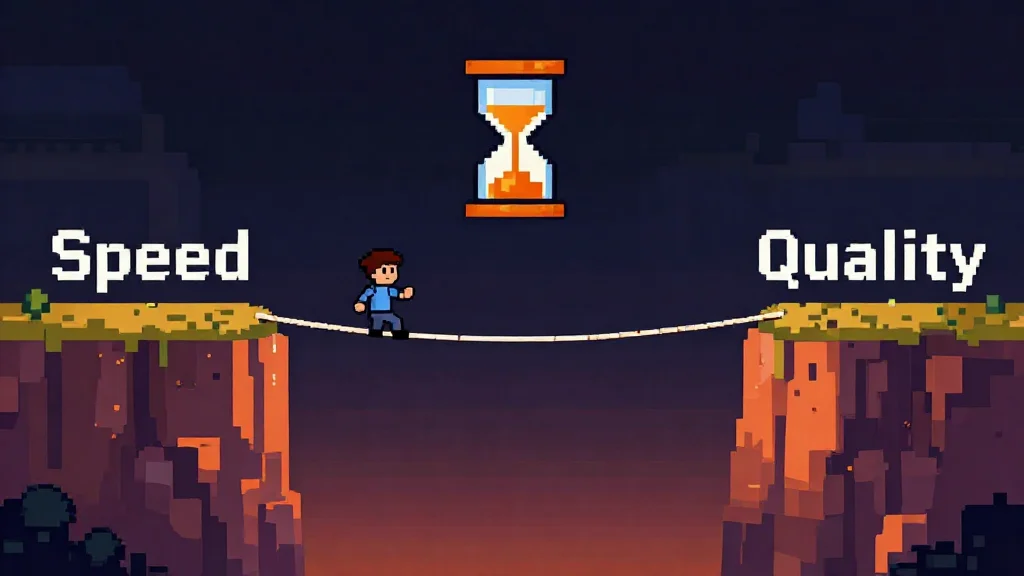
The impossible triangle: balancing speed, quality, and capital.
AI app builders reframe the equation. By automating boilerplate code, integrating payments and authentication upfront, and compressing months of development into weeks, they let you validate product-market fit without the overhead of managing a technical team. According to research from Hostinger, 63% of AI app builder users have no coding background—proof that these platforms have genuinely democratized software creation beyond the developer community.
The critical distinction: vibe coding (rapid prototyping to test ideas) is useful but incomplete. True founders need production-ready code—applications that handle real transactions, scale as users arrive, and don't collapse under load. Quality AI builders and alternative paths to hiring a technical cofounder deliver both velocity and durability, eliminating the false choice between speed and stability.
Top AI App Builders for Founders in 2026: Side-by-Side Comparison
The decision to choose between these platforms hinges on a single question: How close to production-ready does your MVP need to be on day one? Speed matters, but a 48-hour prototype that can't handle real payments or scale is just a demo. The tools below represent the current generation of builders that genuinely compress months into weeks—some for validation-stage founders, others for those ready to launch a SaaS with production architecture from the start.
Tool
Best Use Case
Target Audience
Learning Curve
Ideal For
Lovable
Rapid UI prototyping, non-technical validation
Non-technical founders
Minimal (chat to app)
Testing ideas in 48 hours
Bolt.new
Full-stack SaaS with database and backend
Founders wanting quick SaaS
Low-moderate (prompt-driven)
Building a complete SaaS MVP
Cursor
Custom SaaS with code ownership
Technical founders, founder-developers
Moderate (IDE-based)
Launching production SaaS with flexibility
Replit Agent
Full-stack with integrated hosting
Developers moving fast
Low (hosted infrastructure)
Scaling past MVP with DevOps friction removed
Zite
Business software with compliance, integrations
Non-technical founders building B2B
Moderate (structured workflows)
Enterprise-grade features without a dev team
V0 (Vercel)
React component generation
React developers, technical founders
Moderate (code-first)
Building polished frontends quickly
Devin
Autonomous code generation
Technical founders seeking augmented development
Moderate-high (AI agent-driven)
Complex backend logic and refactoring
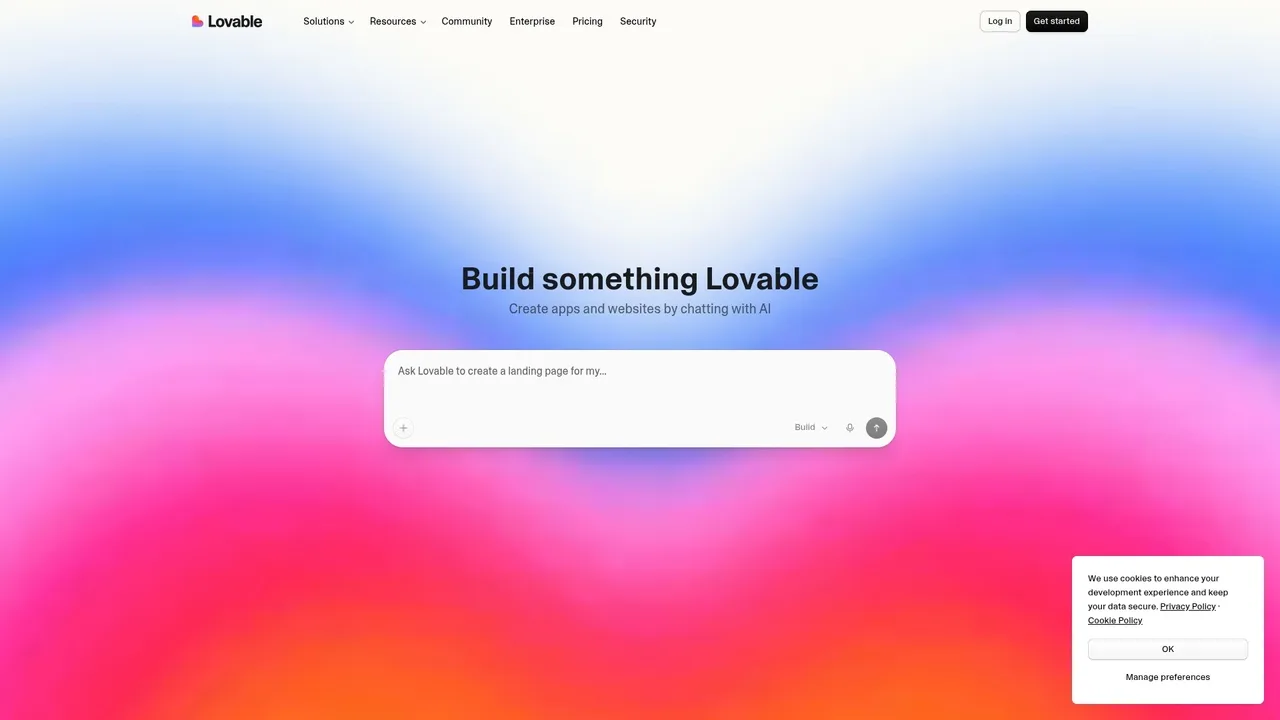
Lovable interface: Chat-driven development for rapid prototyping.
Lovable: Speed-to-MVP Champion for Non-Technical Founders
Lovable strips friction to a single skill: describing what you want. You write a prompt ("Build a task management app where users can log time and export timesheets"), and it generates a functioning frontend with state management, styling, and basic UX patterns—no code required. The platform shines for validating problem-market fit in 48 hours, which means getting a working prototype in front of customers before you've burned capital hiring developers.
The catch: Lovable excels at presentation but struggles with persistent data and external integrations. If your MVP requires Stripe payments, user authentication with a real database, or API integrations, you'll either need custom code layered on top or a pivot to a more full-stack builder. For solopreneurs launching simple SaaS applications—project tracking, feedback collection, lead capture—Lovable is unbeatable. For anything requiring backend complexity, it's a starting point, not a finish line.
Bottom Line for Founders: Choose Lovable if you're a non-technical founder testing an idea with a tight deadline. You'll have a clickable prototype to show customers within a weekend. Just know that production-readiness requires the next tier.
Bolt.new: Full-Stack SaaS Development in a Browser
Unlike Lovable, Bolt.new generates full-stack applications—it builds the frontend and the backend scaffolding with database integration included. You describe a SaaS product ("Build a subscription SaaS for freelance invoicing with Stripe integration"), and Bolt generates a deployable application with user authentication, database schema, API routes, and payment handling. The platform bridges the 48-hour prototype and production-ready code, which is why Bolt is often the better choice for founders asking "Can I launch a SaaS with AI?"—the answer is yes, and Bolt is the vehicle for most founders doing so.
Full-stack development: Frontend, backend, and database combined.
Bolt's Pro plan costs $25 per month for 10 million tokens, allowing continuous iteration. For teams, the plan is $30 per member monthly. The tradeoff: Bolt generates more code than Lovable, which means you inherit a codebase that requires some technical literacy to modify. It's not no-code—it's low-code, and modifications demand understanding of the generated structure.
Bottom Line for Founders: Choose Bolt if you're building actual SaaS (recurring revenue, real users, payments). It gives you a complete, deployable application in days, not months.
Cursor: For Founder-Developers Who Want IDE-Level AI Assistance
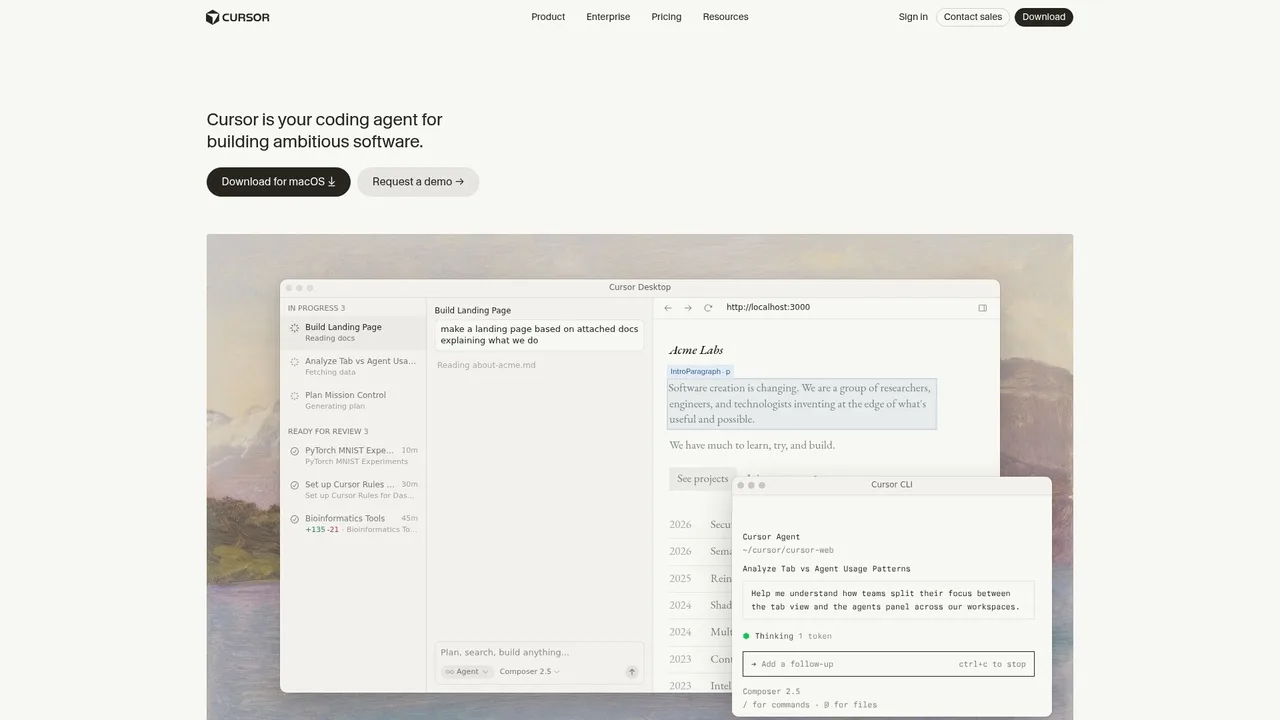
Cursor is an AI-augmented code editor—think VS Code with an AI copilot that understands context, refactors code, and explains complex logic. Unlike Lovable and Bolt, which generate from scratch, Cursor assists development. You still write code (or guide the AI to), but you retain full ownership and customization from day one. This matters for founders with technical backgrounds or those willing to learn to code—you avoid the vendor lock-in of generated platforms.
Cursor has achieved massive adoption (achieving a $29.3 billion valuation by early 2026), and for good reason: it compresses the learning curve for founder-developers building production SaaS. You get the speed of AI-assisted development without sacrificing code quality, architecture decisions, or long-term flexibility. The learning curve is steeper than Lovable's, but the ceiling is infinitely higher.
Cursor IDE: AI-assisted coding for full control.
Bottom Line for Founders: Choose Cursor if you have technical skills or are serious about learning to code. You'll move faster than traditional development and retain complete control over your product roadmap.
Replit Agent & Zite: Production-Grade Tools for Scaling
Once you've validated product-market fit, Replit Agent and Zite unlock scaling. Replit Core costs $17 monthly (billed annually) and includes full Agent access plus $20 in monthly usage credits—you get hosting, collaboration, and production infrastructure without DevOps overhead. Zite targets non-technical founders building enterprise software, with compliance, integrations, and workflow automation built in rather than bolted on.
Neither is ideal for absolute beginners, but both solve the problem of outgrowing MVP-stage tools: they offer reliability, team collaboration, and integrations that support real business operations.
Bottom Line for Founders: Move to these tools after validating your core idea. They're the bridge between AI-assisted MVP and sustainable business infrastructure.
How to Choose the Right AI Builder: Decision Framework for Founders
Picking the right tool feels like trying to solve a multi-variable equation—but it doesn't have to be. The best AI builder for you depends on five simple questions:
1. Timeline constraint: How many weeks do you have before you need to test with users? Most successful startups launched their first MVP within 2–3 months of starting development, so speed is usually non-negotiable.
2. Business criticality: Is this a throwaway prototype to test assumptions, or will it handle real transactions? Throwaway ideas = Lovable or Claude with Artifacts. Revenue-generating products = Cursor, Replit, or Zite.
3. Your technical depth: Be honest about whether you can write basic code or debug errors. Lovable and Zite handle everything. Cursor demands at least functional literacy with code editors and terminal commands.
4. Integration needs: Do you need user authentication, payment processing, or third-party APIs? Lovable and Zite bundle these by default. Cursor leaves you responsible for finding and implementing integrations.
5. Code ownership: How much do you need to modify the product six months from now? Need to own the codebase and hire developers? Cursor. Comfortable staying in a visual builder forever? Lovable or Zite work fine.
Choosing your path: Speed vs. Scalability.
The most effective founders use AI to spec an MVP by first clarifying these constraints. Write down your answers, and the right tool becomes obvious. If you're unsure what features matter most, start with a PRD framework before choosing your builder—it forces you to think clearly about what you're actually building.
From AI Prototype to Production: When DIY Builders Fall Short
The speed is intoxicating. A working prototype in 48 hours feels like victory. But the moment you launch to real users, the reality of AI-generated MVPs becomes obvious: they're fragile systems built for demos, not deployments. When AI-generated code is not enough becomes the question every founder eventually faces—often at the worst possible time.
The 48-Hour MVP: Why Speed Comes With Tradeoffs
AI builders prioritize velocity over robustness. They generate code that handles happy-path scenarios beautifully but lacks the guardrails of production systems. Missing error handling, no validation for edge cases, and infrastructure assumptions that work on your laptop but collapse under user load. You ship Thursday. By Monday, users report payment failures, duplicate records, and timeouts. The builder gave you 95% of the visible feature, but the remaining 5%—input validation, retry logic, data consistency—requires manual refactoring. This isn't a flaw in the tools; it's a feature. They were designed to validate ideas, not scale them.
Technical Debt and Code Ownership
Every line of AI-generated code is a future liability. Tools like Lovable and Zite abstract the codebase away entirely—great for validation, crippling for iteration. You can't debug beyond what the UI allows. You can't hire a developer to modify the product because there's nothing to modify—just a black box. Tools like Cursor leave you with code ownership but saddle you with documentation gaps, non-idiomatic patterns, and code that's difficult for a human team to inherit. By month four, when you've found traction and need to add complex features, you're choosing between rewriting in a proper framework or paying someone to decipher AI outputs.
Knowing When to Hire Professional Development Support
The inflection point arrives at week 12 to 16. You've validated demand. Users want feature X, but your builder can't deliver it. You have three paths: learn to code (slow), hire a junior dev (risky), or partner with a technical team. The decision is financial, not technical. If your MVP is generating revenue, the math shifts. A technical co-founder alternative like a dev agency moves faster than hiring, costs less than equity, and lets you scale from validated traction instead of guessing at unproven ideas.
Founder FAQs: Answering Your Top Questions About AI App Builders
Can I actually launch a real business with an AI app builder? Yes, if scope stays contained. Simple SaaS products, marketplaces, and internal tools succeed regularly. Complex integrations or logic beyond the platform's boundaries will force difficult tradeoffs.
Do I need to learn to code? No. Builders like Bolt and Lovable are designed for non-technical founders. Launching without a developer is entirely viable with the right tool and a crisp MVP scope.
What about security and data privacy? Request compliance documentation before committing. Platforms like Bubble publish SOC 2 and GDPR details. For sensitive customer data, demand actual audit reports rather than marketing promises.
How do I integrate payments? Stripe and PayPal connect directly—one-click integrations, no custom code required.
What if the tool shuts down? Vendor lock-in is the real cost. Cursor leaves you with code ownership; closed platforms don't. Compare no-code versus custom development with exit risk factored into your decision.
Cost versus hiring developers? Builders run $50–500/month; junior developers cost $3k–8k monthly. Builders win on launch speed; developers scale better once you've proven traction.
Your Next Step: Picking a Builder and Building Your Founder MVP
From AI prototype to professional development.
Pick your builder now. Realistic timeline: 2–4 weeks for an MVP that validates your core hypothesis, not 48 hours for production. Use your decision framework—speed versus scalability—and commit to shipping.
Shipping without a developer is entirely viable once traction proves the concept. When growth demands reliability and scale, transition to fixed-price custom development. That's not failure; it's the natural evolution.
The gap between prototyping and profit is filled by founders who iterate fast and adapt faster. Your AI builder is the sprint. Your team scales the marathon.
Ship now. Learn. Hire later.
Article FAQ
Practical next steps
Who is this startup guide for?
This guide is written for non-technical founders, operators, and small teams who need to make product decisions before hiring a full engineering team. It focuses on practical scope, cost, timeline, and execution trade-offs rather than abstract startup theory.
What should I do after reading this article?
Turn the idea into a small decision: validate the riskiest assumption, estimate the build scope, and decide whether the first version should be no-code, custom code, or a hybrid. Shipkit's free estimate and MVP scope builder can help you translate the article into a concrete plan.
Can Shipkit help implement this kind of product?
Yes. Shipkit helps founders turn validated ideas into fixed-scope MVPs, SaaS products, internal tools, marketplaces, and AI-enabled workflows. The best starting point is to get an estimate or compare your build path before committing budget.