Do I Need a Technical Cofounder to Launch My SaaS?
Alex
··9 min read
Many aspiring entrepreneurs wonder, "Do I need a technical cofounder to launch my SaaS?" The straightforward answer is often no, as modern alternatives empower non-technical founders to bring their ideas to life without relying on a coding partner.
Quick Answer: You don't need a technical cofounder to launch your SaaS or MVP. Non-technical founders can build products by hiring developers, using no-code platforms, or partnering with development agencies. The key is choosing the right approach for your timeline, budget, and growth ambitions—then executing decisively.
When a Technical Cofounder Is Actually Essential
Not every startup needs a technical cofounder, but certain scenarios genuinely benefit from one. The key is distinguishing between real technical constraints and the myth that you can't succeed without deep engineering expertise on your founding team.
Technical cofounders raise 14% more capital on average than non-technical founders, according to Startup Compass—but that correlation doesn't prove causation. Investors may simply perceive technical depth as risk mitigation. The real question is whether your specific product requires it.
Complex Infrastructure and Custom Technology
Some products demand architectural decisions that shape the entire company. If you're building a real-time collaborative platform with sub-100ms latency requirements, a machine learning system with proprietary algorithms, or infrastructure handling millions of concurrent connections, you need someone who understands these constraints during product definition—not after launch.
The problem isn't that non-technical founders can't manage this work. They can. The problem is that without technical depth on the founding team, you'll make product decisions that later require expensive rewrites. A technical cofounder catches these issues early, when pivoting costs weeks instead of months.
Similarly, if your competitive advantage depends on custom-built technology—not just using existing APIs—having someone who can architect that system from day one matters. This applies to startups building proprietary data processing, complex integrations, or cutting-edge AI applications where off-the-shelf solutions won't suffice.
When You're Bootstrapping With Zero Budget
A technical cofounder becomes attractive when you have a startup idea but no developer and no capital to hire one. They can build for free while you handle everything else. This sounds ideal until you realize the hidden costs: slower progress than a paid team, equity dilution, and the risk that your cofounder burns out or leaves.
Bootstrapping with a technical cofounder works if they're genuinely committed to the vision and can sustain themselves financially during the build phase. It fails when founders expect free engineering indefinitely or when the cofounder has competing priorities.
The alternative—using a fixed-price development agency—costs money upfront but compresses your timeline and removes the equity negotiation. For most non-technical founders, this trade-off favors speed and clarity over equity preservation.
Three Proven Alternatives to Finding a Technical Cofounder
The absence of a technical cofounder doesn't mean your SaaS product stays stuck in the idea phase. Non-technical founders today have access to three distinct, battle-tested paths forward—each with different trade-offs in speed, cost, and long-term flexibility. Understanding when to use each one is the real skill.
No-Code and Low-Code Platforms — Build Without Writing Code
The appeal is real: you design workflows visually, connect databases without SQL, and launch without touching code. Bubble excels at web applications with complex logic. FlutterFlow specializes in mobile apps and offers a critical advantage—it exports functional Flutter code that runs independently of the platform, so you're not locked in forever. Zapier handles automation and integrations between existing tools.
The catch matters. Bubble has no code export; if you outgrow it, you rebuild from scratch. FlutterFlow's exported code is production-ready but still requires a developer to maintain and extend long-term. These platforms work best for MVPs with straightforward user flows, standard payment processing, and limited custom integrations. They struggle with proprietary algorithms, real-time data processing, or highly specialized workflows. If your SaaS idea involves complex business logic or unique technical requirements, no-code becomes a ceiling, not a launchpad.
Hiring a Development Agency or Technical Team — Speed and Ownership
A full-service development agency compresses your timeline dramatically. Instead of searching for a cofounder, negotiating equity, and hoping they stay committed, you hire professionals, pay a fixed price, and own the result from day one. Agencies typically charge $50,000–$250,000 per project for SaaS MVP development, with most MVPs landing in the $30,000–$100,000 range depending on complexity.
The advantage over freelancers is accountability and structure. A boutique agency assigns a dedicated team, manages project scope, and delivers production-ready code with integrated payments, user authentication, and business logic included. You maintain 100% code ownership and can hire your own developers later to extend the product. This approach works especially well if you need your MVP in under three months or if your product has complex integrations that require coordinated engineering effort.
The trade-off is upfront capital. You're paying cash instead of diluting equity, which matters if you're bootstrapping. However, fixed-price development eliminates the scope creep and budget surprises that plague hourly engagements. You know the cost before work begins.
AI-Assisted Development and Fractional CTOs — Guidance Without a Full Cofounder
The newest alternative leverages AI tools and fractional technical leadership. GitHub Copilot and ChatGPT have made it possible for developers to write code 55% faster, and about 41% of all code written in 2025 is AI-generated. But for non-technical founders, the real value lies in hiring a fractional CTO—a part-time technical advisor who guides your development decisions without the equity commitment or full-time salary of a cofounder.
Fractional CTOs typically charge $150–$500 per hour, with monthly retainers ranging from $3,000–$15,000. They help you architect your product, vet development partners, manage technical debt, and make infrastructure decisions. Combined with an agency or outsourced team, a fractional CTO ensures your product is built on solid foundations without requiring you to understand every line of code. This model works best if you want technical credibility in investor conversations or need guidance navigating complex decisions about scalability and security.
The limitation is that a fractional CTO doesn't build your product—they advise on how it should be built. You still need developers, whether in-house, outsourced, or through a no-code platform. This approach shines when you've already validated your idea and need strategic technical input, not when you're starting from zero.
Critical First Steps Before Pursuing Any Technical Path
Before writing a single line of code or booking a call with a developer, non-technical founders must lay the groundwork that determines whether their SaaS will solve a real problem — or vanish into obscurity. Your success doesn't hinge on technical talent first; it hinges on clarity. Founders with an idea but no tech team often rush to build, only to waste time and money on features no one wants. The smart path? Validate, define, and document — in that order.
Validate Your Market and Define Core Features
You don't need a prototype to test demand. Start by talking to at least 20 potential customers. Ask about their pain points, current workarounds, and willingness to pay. This customer discovery process eliminates guesswork and sharpens your value proposition. Once you confirm interest, prioritize only the core features that deliver your primary benefit — everything else is noise at this stage. A focused MVP reduces development cost and accelerates time to market, whether you're working with freelancers, an agency, or a technical cofounder.
Create a Detailed Product Specification Document
A vague idea takes 10x longer to build than a well-defined one. Your product specification should outline user flows, key screens, data requirements, and business logic in plain language. Think of it as a blueprint: the more precise, the fewer surprises during development. This document becomes your single source of truth for any technical partner and aligns everyone on scope — helping avoid costly changes later. For guidance on structuring your MVP, see our practical guide to building a startup without a technical cofounder.
The Hidden Costs of a Technical Cofounder (That Nobody Discusses)
The narrative around technical cofounders is seductive: find the right developer, split the equity, and suddenly your idea becomes reality. But this story glosses over the friction that derails many partnerships before the product even launches.
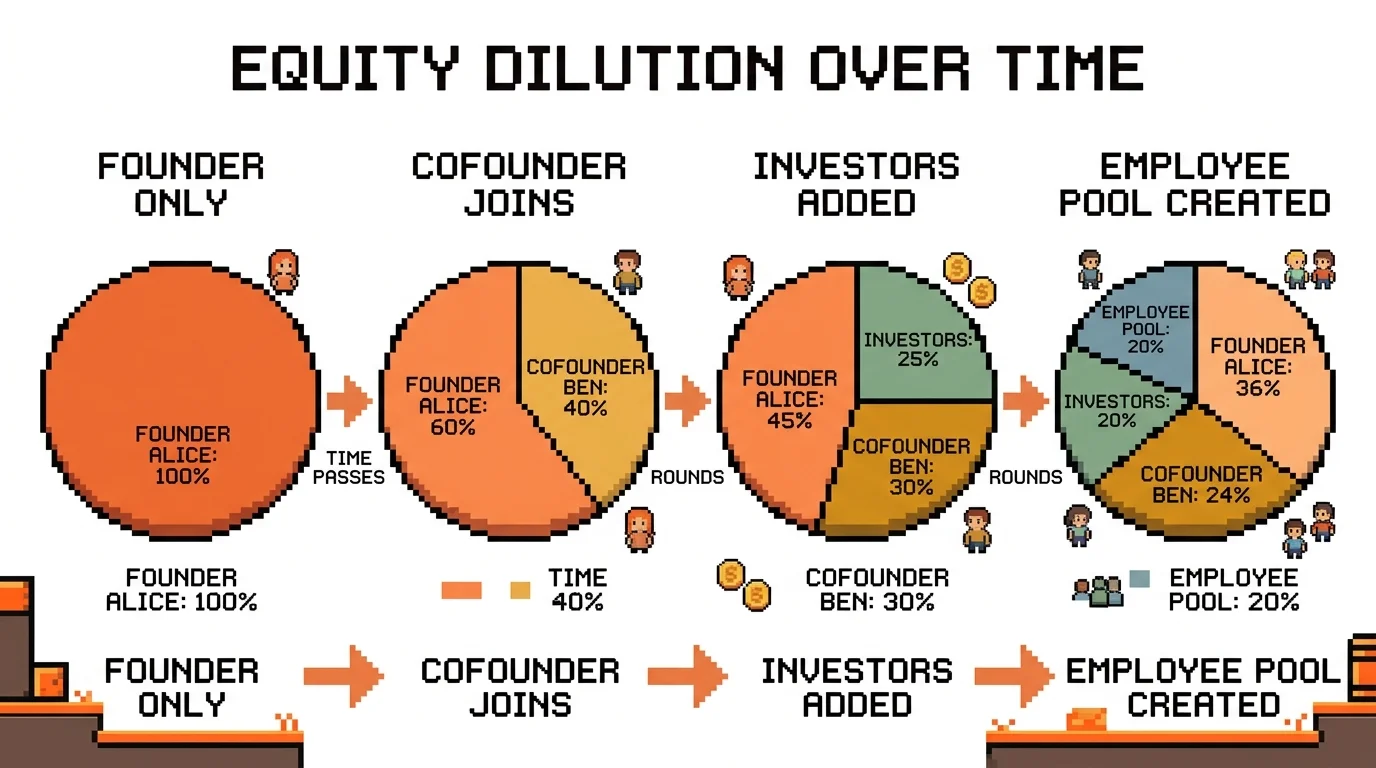
Equity dilution is the first invisible cost. When you bring in a technical cofounder, you're typically giving up 20–50% of your company. According to Carta's 2024 founder equity data, equal splits among cofounders have become increasingly common, rising from 31.5% to 45.9% for two-person teams. That stake compounds over every funding round, every new hire, and every exit opportunity. Even a modest equity grant to a technical cofounder can cost you millions in a successful exit—money that could have gone toward hiring, marketing, or your own financial security.
The deeper problem is misalignment. Technical skill and business judgment are separate talents. A brilliant engineer might be indifferent to customer discovery, dismissive of your target market, or insistent on building features that sound cool but solve no real problem. Personality clashes and differing visions on product direction are common friction points. When disagreements arise, there's no clear resolution—you're locked into a partnership that's harder to unwind than a bad marriage.
Non-technical founders also face a knowledge asymmetry. You can't easily evaluate whether your cofounder is making sound technical decisions or just protecting their domain. This dependency can breed resentment and limits your ability to course-correct if things go sideways.
The alternative path—working with an external development partner—eliminates these hidden costs. You retain full equity, maintain decision-making control, and can pivot without navigating cofounder politics. When you're ready to scale, you can choose between an agency or freelancer based on your timeline and budget, rather than betting your company on a single person's commitment and capability.
Making Your Decision: Technical Cofounder vs. Alternatives in 2025
As you weigh whether to pursue a technical cofounder or explore other routes, remember: the best choice depends on your product’s complexity, your budget, and how much control you want over technical decisions. For many non-technical founders, the most effective path isn’t waiting for a cofounder—it’s taking decisive action using modern tools and services that make independent progress possible.
Before committing to any route, ensure you’ve laid the proper foundation. Validating your idea and clearly defining your core features is critical—without this, even the most skilled developer or advanced no-code platform won’t save you from building something nobody wants. Be sure to review our section on Critical First Steps Before Pursuing Any Technical Path to avoid common pitfalls that derail early-stage founders.
Ultimately, the question “Do I need a technical cofounder to launch SaaS?” has evolved. In 2025, the answer is increasingly leaning toward no—thanks to no-code tools, AI-assisted development, and accessible engineering talent. Your job isn’t to become a coder or find a savior with a GitHub profile. It’s to lead, validate, and execute with clarity.
Article FAQ
Practical next steps
Who is this startup guide for?
This guide is written for non-technical founders, operators, and small teams who need to make product decisions before hiring a full engineering team. It focuses on practical scope, cost, timeline, and execution trade-offs rather than abstract startup theory.
What should I do after reading this article?
Turn the idea into a small decision: validate the riskiest assumption, estimate the build scope, and decide whether the first version should be no-code, custom code, or a hybrid. Shipkit's free estimate and MVP scope builder can help you translate the article into a concrete plan.
Can Shipkit help implement this kind of product?
Yes. Shipkit helps founders turn validated ideas into fixed-scope MVPs, SaaS products, internal tools, marketplaces, and AI-enabled workflows. The best starting point is to get an estimate or compare your build path before committing budget.