No-Code vs Custom App Development for Startups: Which Path Wins in 2026
Alex
··16 min read
You're staring at two very different paths forward. One promises to get your MVP live in weeks with minimal upfront cost. The other demands significant investment but offers unlimited flexibility and full ownership from day one. Both work—but they work for entirely different founders, at entirely different stages, with entirely different risk profiles.
The choice between no-code platforms and custom app development isn't about which is objectively "better." It's about which one aligns with your timeline, budget constraints, and long-term product vision. A founder bootstrapping with $20K and a hard launch deadline faces a completely different calculus than one raising $500K and planning to scale aggressively for three years. The real question isn't no-code versus custom code—it's which trade-offs you're willing to live with.
Quick Answer: Choose no-code if you need to validate your core idea in 4–8 weeks with minimal budget and don't anticipate complex integrations or high user volumes. Choose custom development if you need a proprietary product, plan to raise funding, expect rapid scaling, or require sophisticated features that no-code platforms struggle with. The decision ultimately depends on whether you're buying time to prove demand, or building a defensible product to grow into a sustainable business.
This article walks you through the real decision framework. You'll see exactly what each path delivers, where each one breaks down, and how to spot the warning signs that you've chosen wrong. We'll also explore why many founders actually start with one approach and migrate to the other—and what that transition costs when it happens.
The Real Difference: No-Code Platforms vs Custom Development Explained
For 2026 price ranges by complexity tier, see our full MVP development cost guide.
These two approaches deliver fundamentally different products—and understanding what each one actually produces is critical before you commit time and capital.
What No-Code Platforms Actually Do (and Don't Do)
No-code platforms like Bubble, Lovable, and Bolt provide visual builders and pre-built logic blocks that let you assemble applications without writing code. You drag components onto a canvas, configure workflows through graphical interfaces, and deploy to live users in days or weeks. According to industry research on no-code efficiency, these platforms can reduce development time by up to 90% compared to traditional methods, compressing months of work into weeks.
The catch is real. No-code tools work well for specific use cases—landing pages, simple internal tools, basic marketplaces, form-heavy applications—but they hit hard walls when you need complexity. You're locked into the platform's architecture, which means custom integrations become expensive or impossible, performance degrades under heavy user load, and scaling beyond a few thousand concurrent users requires workarounds that defeat the purpose of using no-code in the first place. Database customization, advanced security requirements, and proprietary business logic often force you to rebuild in custom code anyway. You also depend entirely on the platform's roadmap and pricing—if Bubble changes its pricing model or sunsetting a feature you rely on, you have limited recourse.
What Custom Development Delivers
Custom development means building your product from the ground up with full code ownership, unlimited architectural flexibility, and genuine scalability. You own the codebase, the infrastructure, and the database schema. You can integrate with any third-party service, implement sophisticated features without workarounds, and optimize performance for millions of users if needed.
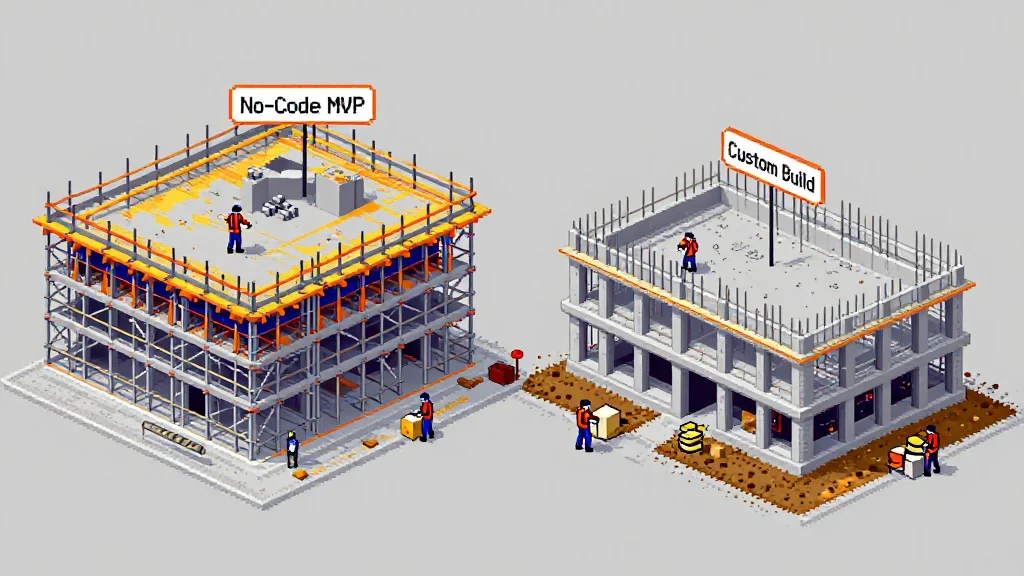
The tradeoff is upfront cost and timeline. Custom development requires more capital and takes longer to reach a launchable product—typically 8–12 weeks for an MVP compared to 2–4 weeks with no-code. But you're building a defensible product that can grow with your business. If you plan to raise funding, custom development is the standard expectation. Investors want to see that you own your technology and can scale without vendor constraints. You also avoid the costly migration problem: many founders who start with no-code platforms eventually need to rebuild in custom code, which can cost $15,000 to $100,000+ depending on complexity.
The real distinction isn't about code quality or technical sophistication—it's about control, ownership, and what happens when your product succeeds. No-code gets you to market fast when you're validating whether people want your solution. Custom development gets you a sustainable foundation when you're building a business that needs to scale, integrate deeply, and remain independent from vendor decisions.
Speed vs Ownership: The Five Critical Differences That Matter Most
The choice between no-code and custom development isn't abstract—it's about five concrete factors that determine whether your startup thrives or gets trapped. Here's what actually matters when you're deciding which path to take.
Speed is seductive. When you're burning cash and investors are asking when you'll have something to show, the promise of a working prototype in 2–4 weeks feels like a lifeline. According to research from Adalo, 72% of users successfully develop applications in three months or less using low-code platforms, compared to traditional development cycles of 6–12 months.
But this speed comes with hidden costs. Every feature you build on a no-code platform creates technical debt—workarounds, custom logic that lives outside the platform, integrations held together with automation rules. When your product gains traction and you need to customize payment flows, add complex user permissions, or integrate with enterprise systems, you'll hit the platform's ceiling hard. Many founders discover too late that what took weeks to build on Bubble or Webflow will cost $15,000 to $100,000+ to rebuild in custom code—a problem known as the migration trap.
The real question isn't whether you can launch fast with no-code. You can. The question is whether you're willing to pay twice: once to validate your idea on a platform, and again to rebuild it properly when you succeed.
The True Cost Conversation Most Founders Miss
No-code platforms advertise low entry costs—often free or under $5K to get started. Bubble's pricing starts at $32 per month for basic features, scaling to $134+ monthly as your app grows. This feels manageable until you map total cost of ownership over 2–3 years.
Custom development costs $25,000–$50,000 upfront for a functional MVP, with the average custom mobile app development ranging from $40,000 for basic solutions to $171,450 for more complex applications. That's a painful check to write. But after launch, your costs stabilize. You pay your development team (or agency) for new features, not for the privilege of existing.
With no-code, your monthly fees compound. A growing app on Webflow or Airtable can cost $500–2,000+ monthly just to keep the lights on. Over three years, that's $18,000–72,000 in platform fees alone—before you add any new features. Custom development, by contrast, gives you a fixed asset. You own the code. You control the infrastructure. You're not renting your product's foundation from a vendor.
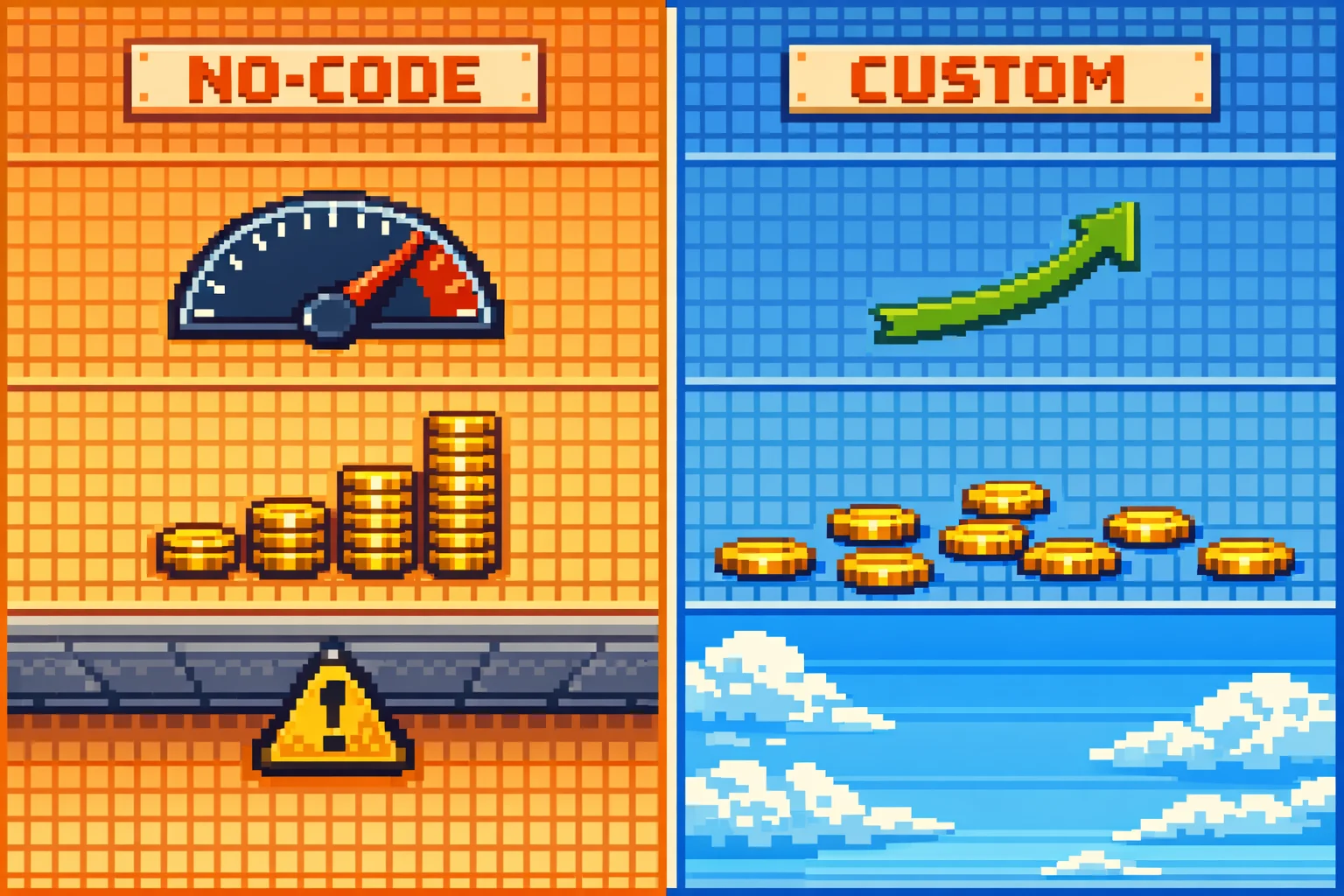
This math flips the narrative: custom development looks expensive upfront but becomes cheaper at scale. No-code looks cheap at first but becomes expensive as you grow—and you can't escape the fees without rebuilding from scratch.
Choose No-Code When: Five Scenarios Where Speed Justifies the Trade-Offs
No-code isn't universally wrong—it's situationally right. The trade-offs become acceptable when speed matters more than permanence, when you're testing rather than building forever, and when the cost of delay exceeds the cost of platform lock-in. Here are the five scenarios where no-code genuinely wins.
The Idea Validation Stage: When No-Code Wins
You have a hypothesis, not a proven business. You need to answer one question: Do people actually want this? No-code lets you answer it in 3–4 weeks for under $5,000. A custom development path takes 8–12 weeks and $25,000–$50,000 before you know if the market cares.
The math is brutal: if your idea fails (and 42% of startups fail because there's no market need for their product), you've lost minimal capital and time with no-code. With custom development, you've burned a quarter and a significant chunk of runway. Early-stage founders should use no-code to validate demand before committing serious money to custom code. Once you've proven the idea works and users are paying, migration becomes a strategic choice, not a panic.
The Funding Pre-Launch: Building Momentum Before Capital
Investors don't fund wireframes—they fund traction. A no-code MVP with 50–100 active users and real usage data attracts more investor interest than a polished pitch deck with no users. Founders use no-code in the 6–8 weeks before pitching to build a working demo, acquire early customers, and prove the concept moves.
This is explicitly temporary. You're not building the final product; you're building proof. VCs understand this. They see founders who shipped fast on Bubble or Webflow as scrappy and execution-focused. The conversation shifts from "Will this work?" to "How do we scale what's working?" At that point, you have leverage to negotiate a custom development engagement or hire a development partner. You're not starting from zero—you're starting from product-market signals.
Internal Tools and Operational Workflows
Your operations team is drowning in spreadsheets. You need a database, a dashboard, and a way to automate approvals. This doesn't need to be a customer-facing product. No-code tools like Airtable, Zapier, and Softr solve this in days. The upside is immediate (your team saves 10 hours per week). The downside—vendor lock-in—barely matters because you're not selling this to customers.
Internal tools are the perfect no-code use case. You're not betting your business on Airtable's roadmap. You're solving a real problem today without hiring engineers. If it breaks or you outgrow it, you migrate. The cost of waiting for custom development is higher than the cost of eventual migration.
Simple Marketplaces and Standard SaaS Features
If your MVP is a two-sided marketplace with basic matching, messaging, and payments—and you're not building proprietary algorithms or complex integrations—no-code can work. Bubble, FlutterFlow, and similar platforms have payment processing, user authentication, and database logic baked in. You're not inventing anything new; you're combining existing patterns.
This works until it doesn't. The moment you need custom logic, real-time notifications at scale, or complex reporting, you hit the ceiling. But for the first 6–12 months, while you're learning what your users actually need, no-code gets you there. When you're ready to scale or differentiate, you'll understand the business well enough to justify custom development.
Testing a New Market or Pivot Quickly
You've built a successful product in one vertical. You want to test whether it works in another market without committing engineering resources. No-code lets you clone your core flows, rebrand, and launch in a new market in 2–3 weeks. If it gains traction, you invest. If it doesn't, you've lost minimal time and money.
The risk here is real—you might discover that your core product doesn't translate. But the cost of that discovery with no-code is far lower than custom development. You're treating the new market as a hypothesis, not a commitment.
The honest truth: No-code wins when speed and learning matter more than control and permanence. Once you've validated the idea, acquired users, and proven the business model, the trade-offs flip. At that point, custom development becomes the cheaper, faster, and more flexible path forward. The founders who struggle are those who treat no-code as a permanent solution rather than a temporary tool for validation.
Choose Custom Development When: The Signals That No-Code Will Hold You Back
You need deep, custom integrations
Multiple third‑party APIs, webhooks, and event-driven workflows (e.g., syncing Stripe, Plaid, and a custom underwriting engine) quickly hit the limits of visual builders.
You end up with brittle chains of plugins and Zapier-style automations that are hard to debug and impossible to optimize.
If your roadmap looks like an integration map, custom development is safer and usually cheaper over 12–18 months.
Performance is part of the product, not a "nice to have"
Real-time dashboards, heavy analytics, or collaboration features (think Figma-style cursors or live order books) demand tight control over queries, caching, and infrastructure.
On no-code, you're stuck with generic database abstractions and shared hosting; you can't tune indexes or architecture to your workload.
For internal tools, you can sometimes live with this; for a customer-facing SaaS, it becomes a growth ceiling.
Your edge is proprietary logic or algorithms
If your differentiation is a recommendation engine, dynamic pricing rules, or ML-based scoring, you can't afford to be boxed into a platform's logic editor.
A fintech app with custom risk modeling, AML rules, and fraud detection simply cannot live long-term inside Bubble or similar tools; you'll be fighting the platform instead of improving your model.
Fintech teams also need to encode AML/KYC, PCI DSS, and data privacy rules in code paths that can be audited and tested, which requires bespoke architectures.
Compliance, security, and data residency are non‑negotiable
Healthcare, finance, and HR products often require strict control over where data lives, how it's encrypted, and who can access which records.
Shared, opaque infrastructure makes it hard to prove compliance or pass enterprise security reviews.
If you're already thinking about SOC 2, HIPAA, or bank partnerships, skip no-code and go straight to a custom stack.
Your 12‑month roadmap clearly outgrows no-code
If you already know you'll need multi-tenant architecture, complex role-based permissions, or custom billing logic, you're signing up for a rebuild.
Founders routinely underestimate the cost and delay of moving from Bubble to a custom app; understanding the real migration cost from Bubble to custom code often changes the "no-code first" calculus.
In these cases, the "best way to build an MVP" isn't no-code vs AI vs a solo freelancer—it's starting with a focused custom build, typically with a product agency that behaves like a technical cofounder rather than a collection of hourly contractors.
The Hybrid Path Most Successful Startups Actually Take
Most founders don't actually choose between no-code and custom development—they choose both. The hybrid approach has become the de facto path for uncertain founders: validate your core idea with no-code speed, then migrate to custom code once you've proven product-market fit and understand your technical requirements. It sounds pragmatic. It often isn't.
The hybrid path trades certainty for optionality. You move fast initially, learning what users actually want without betting the entire company on architectural decisions you can't reverse. But this apparent safety net comes with real costs—both visible and hidden. Migration isn't a simple data export; it's a full rebuild. You'll rewrite authentication, redesign your database schema, rebuild workflows that seemed logical in Bubble but need to be restructured for scalability. The code you wrote to validate an idea becomes technical debt the moment you decide to scale.
### The Migration Reality: What Actually Happens When You Switch
When you're ready to move from no-code to custom development, you're not migrating—you're starting over. Bubble doesn't export usable code. Webflow doesn't produce a foundation for a SaaS product. What you get is a working prototype that proved your concept, but that prototype was built on assumptions that won't hold at scale.
The actual costs are substantial. Migration from no-code platforms typically requires 4–8 weeks of development time and $10K–$25K in engineering costs, often more expensive than building custom from the start. A Dallas-based startup that migrated from Bubble to custom Next.js code achieved over 70% decrease in load times and 100x scalability improvement, but that success required a complete rebuild—you cannot simply export code from Bubble and iterate on it.
Beyond engineering hours, you'll face data migration complexity, the risk of losing user records during transition, and the operational burden of running two systems in parallel while you build the new one. Your users stay on the no-code version while your team builds the replacement; any bugs in the legacy system still need fixes, and any new features you ship during migration need to exist in both places. This coordination overhead is often underestimated.
The hybrid path only makes sense if you're genuinely uncertain about product-market fit. If you already know your 12-month roadmap will demand multi-tenant architecture, role-based permissions, or custom billing logic, you're paying twice—once to validate with no-code, again to build what you should have built from the beginning. Understanding the real cost and timeline of migrating from no-code platforms often changes the calculus entirely.
If you do choose the hybrid path, build with migration in mind. Use standard data structures instead of exotic no-code features. Keep your workflows simple and document them thoroughly. Avoid platform-specific customizations that won't translate. The goal isn't to create a perfect no-code product—it's to create a validated prototype that can be rebuilt cleanly, not a tangled mess that requires archaeological excavation before development can begin.
Making Your Decision: The Framework That Works
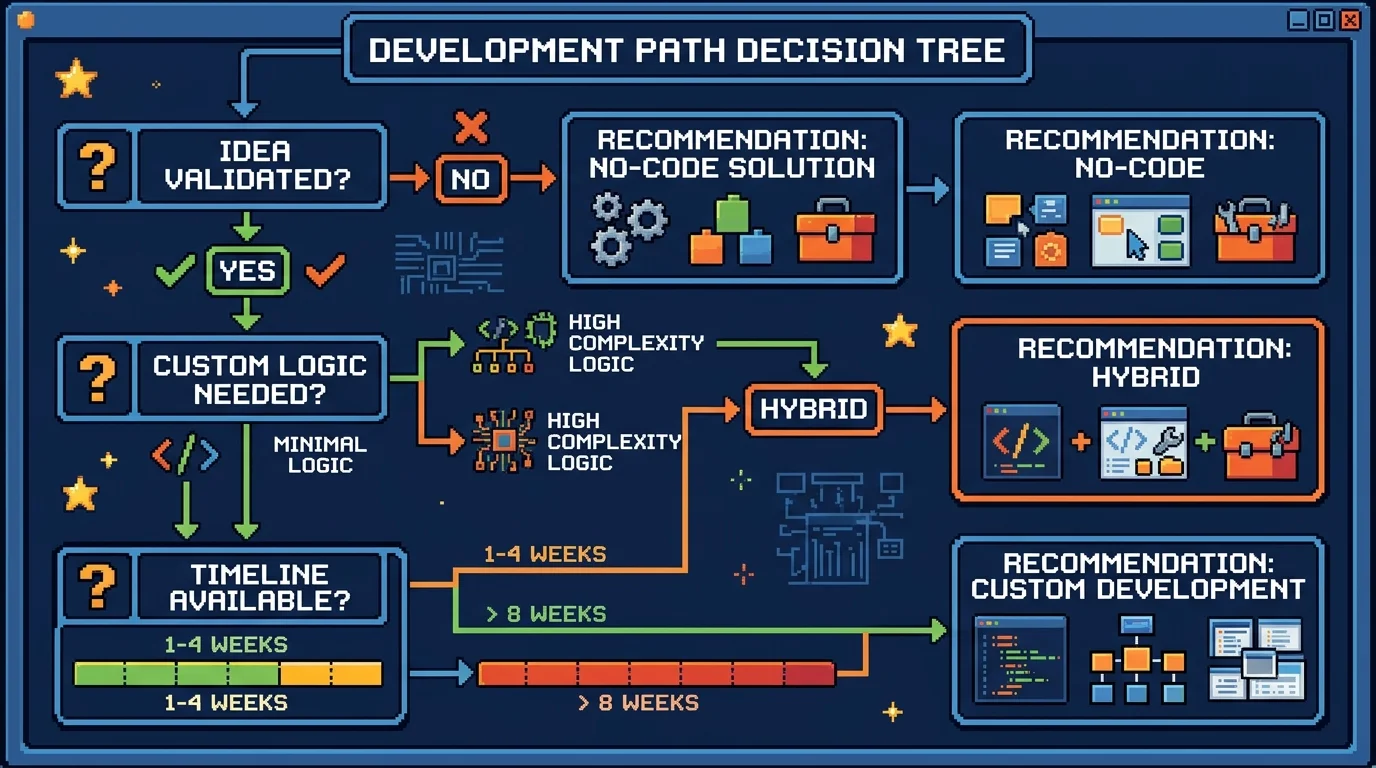
The choice between no-code and custom development comes down to three questions. Answer them honestly, and your path becomes clear.
Question 1: Is your idea validated, or are you still testing? If you're pre-product-market fit—still figuring out whether customers actually want what you're building—no-code wins on speed and reversibility. You can test assumptions in weeks, not months. But if you've already validated demand through conversations, pre-sales, or a landing page with real signups, the cost of rebuilding later becomes your real problem. Custom development makes sense once you know what you're building.
Question 2: Can your product run on standard features, or does it need custom logic? Most early-stage MVPs don't need anything exotic. Authentication, payment processing, basic workflows—these work fine in no-code platforms. But if your competitive advantage depends on custom integrations, algorithmic logic, or behavior that no-code platforms don't natively support, you're fighting the tool. Custom development lets you build exactly what your business requires.
Question 3: Do you have 6-12 weeks for development, or do you need a working demo in 3 weeks? This is about runway and investor expectations. No-code gets you moving faster. Custom development takes longer upfront but gives you a product that scales without architectural rewrites.
If you're uncertain about your answers—or if you're caught between the two—talking to someone who understands both paths helps. A technical co-founder alternative or development agency can assess your specific situation and recommend whether no-code, custom development, or a hybrid approach makes sense for your timeline and product vision. Shipkit, for example, delivers production-ready custom MVPs with full code ownership in fixed timelines, eliminating the uncertainty of traditional development.
The wrong choice costs months and money. The right one gets you to market and learning from real users.
Article FAQ
Practical next steps
Who is this startup guide for?
This guide is written for non-technical founders, operators, and small teams who need to make product decisions before hiring a full engineering team. It focuses on practical scope, cost, timeline, and execution trade-offs rather than abstract startup theory.
What should I do after reading this article?
Turn the idea into a small decision: validate the riskiest assumption, estimate the build scope, and decide whether the first version should be no-code, custom code, or a hybrid. Shipkit's free estimate and MVP scope builder can help you translate the article into a concrete plan.
Can Shipkit help implement this kind of product?
Yes. Shipkit helps founders turn validated ideas into fixed-scope MVPs, SaaS products, internal tools, marketplaces, and AI-enabled workflows. The best starting point is to get an estimate or compare your build path before committing budget.