How Much Does Bubble to Custom App Migration Cost? A Complete Guide
Alex
··13 min read
Understanding the true bubble to custom app migration cost is crucial for startups transitioning from no-code platforms like Bubble to a more scalable, custom-built solution—it refers to the total investment required to rebuild and transfer your application’s functionality, data, and integrations from Bubble into a fully customized, code-based environment.
Quick Answer: Migration costs typically range from $15,000 to $100,000+ depending on your app's complexity, the number of features you're moving, and your custom development partner. A simple CRUD app with basic integrations lands near the lower end, while feature-rich applications with complex business logic, payment systems, and multi-user workflows push toward $50,000 and beyond. Timeline usually spans 4–12 weeks, and you'll want to budget an additional 20–30% for unforeseen complications and refinements during the transition.
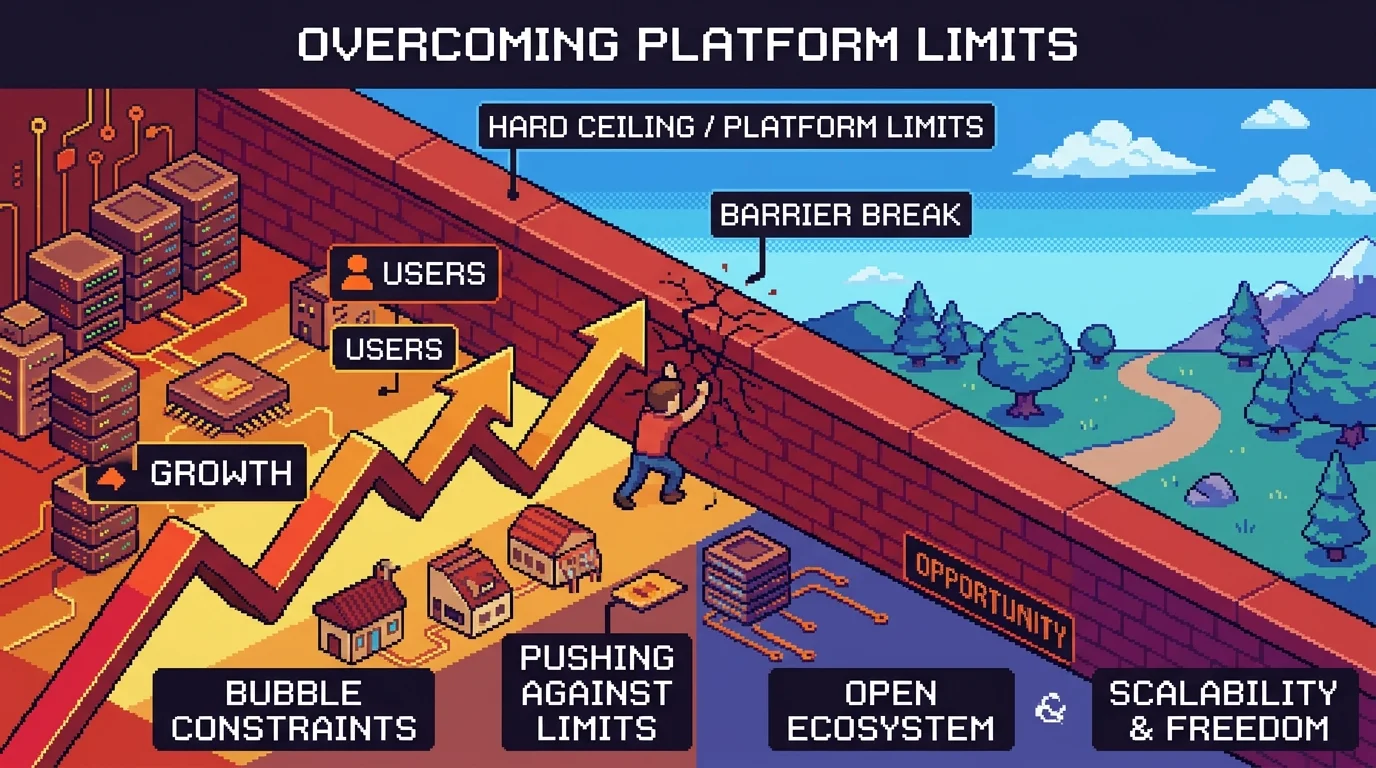
The decision to move from no-code to custom development rarely happens overnight. It emerges gradually—as you notice Bubble's performance ceiling, encounter workflow constraints that no-code workarounds can't solve, or realize that scaling your user base requires infrastructure and customization that the platform simply doesn't support. By the time you're seriously researching migration costs, you've likely already felt the friction.
This article walks you through the actual cost drivers, helps you identify whether you've truly outgrown Bubble, and shows you what to expect from the migration process. We'll break down the pricing variables, compare different development approaches, and explain what factors separate a $20,000 migration from a $150,000 one. Whether you're building a marketplace, a SaaS tool, or an internal operations platform, understanding these costs upfront keeps you from making expensive mistakes or underestimating your budget.
Why Startups Outgrow Bubble and When Migration Becomes Necessary
For 2026 price ranges by complexity tier, see our full MVP development cost guide.
Performance and Scalability Limitations
Bubble's architecture begins to strain when applications exceed 1,000 active concurrent users or handle complex data operations at scale. Page load times degrade noticeably as database queries slow down—especially when filtering, searching, or joining large datasets. Workflows that execute instantly with 100 users suddenly timeout or fail with 10,000 users, creating a cascading problem: your app becomes unreliable precisely when you're trying to grow.
The platform's single-threaded execution model means that complex filtering operations, recursive workflows, and multi-step business logic compete for the same computational resources. A marketplace that smoothly handles 50 concurrent searches will choke when that number hits 500. You can't simply "optimize" your way out of this—the limitation is architectural, not accidental. Many founders discover this breaking point only after their product gains traction, leaving them scrambling to rebuild.
The Unexpected Cost Spiral
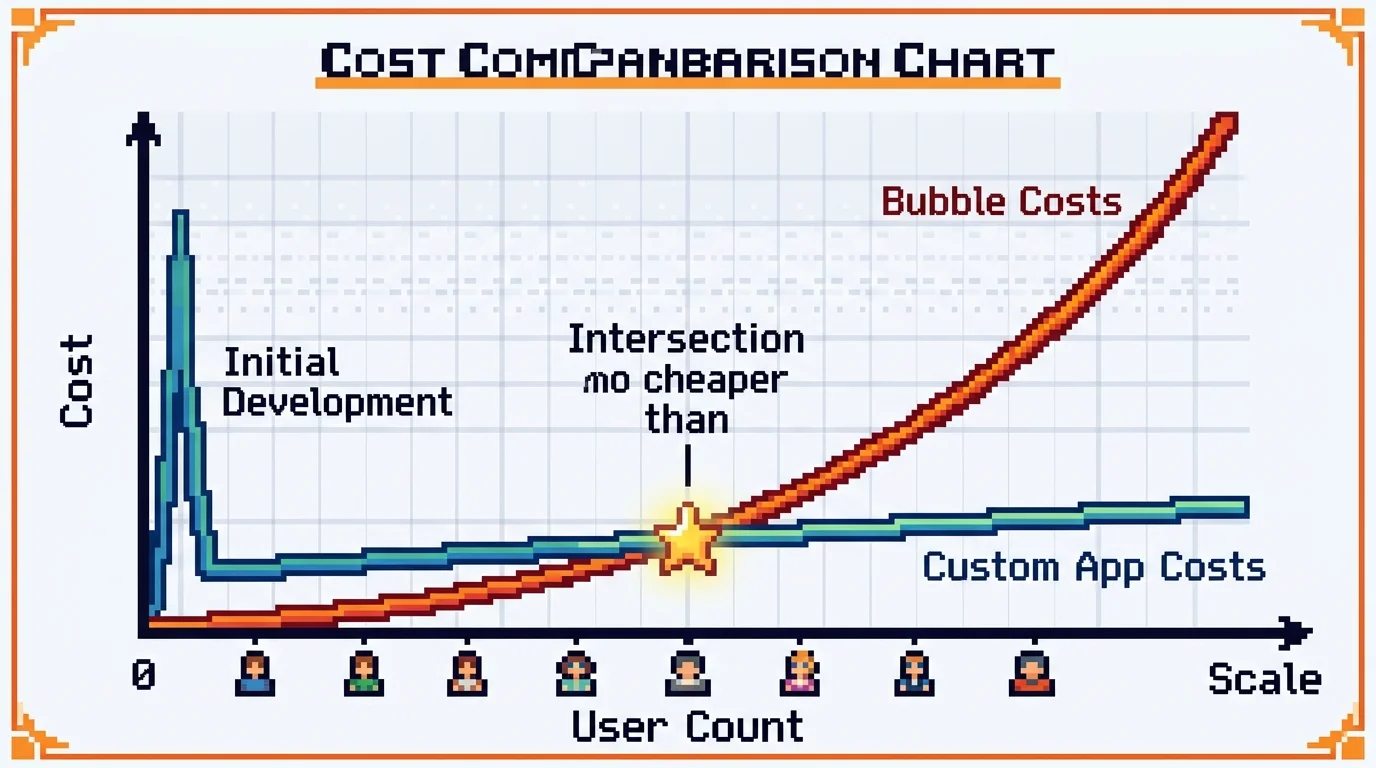
What makes Bubble deceptively attractive at first is the transparent pricing: $349/month for the Team plan sounds reasonable. But according to Bubble's official documentation, that plan includes 500,000 workload units per month. Overage charges kick in at $0.30 per 1,000 units—a cost structure that becomes brutal once your app gains real users.
A SaaS tool processing 10 million monthly workload units faces overage bills exceeding $2,500 on top of the base subscription. Scale to 50 million units, and you're paying $14,500 monthly just for Bubble's infrastructure. At that point, a custom-built application with predictable hosting costs ($500–$2,000/month) becomes dramatically cheaper. Organizations waste an average of 28% of their no-code platform spend annually due to oversized resources and workload unit overages, according to the Flexera State of the Cloud Report—a painful lesson most founders learn too late.
The math is stark: if you're spending $10,000+ monthly on Bubble, a $40,000–$60,000 custom migration pays for itself within 6–8 months while giving you permanent cost control and the ability to scale without surprise bills.
Breaking Down the True Cost of Bubble to Custom App Migration
The decision to migrate from Bubble hinges on a single question: does the total cost of ownership favor staying put or moving forward? The answer depends entirely on your app's complexity, user base, and growth trajectory. Rather than treating migration as a binary yes-or-no choice, think of it as a financial calculation across three realistic scenarios that match how founders actually build and scale.
Custom app development costs vary dramatically based on scope. According to analysis of over 5,000 projects, most business applications with user accounts, payment processing, and API integrations fall between $50,000 and $120,000. However, the true cost of migrating from a no-code platform to custom code includes far more than initial development—you're factoring in data migration complexity, parallel running periods, testing rigor, and post-launch stability work. Understanding these three tiers helps you model your specific situation.
Small App Migration ($15K–$35K)
A small app typically serves fewer than 100 active users with straightforward workflows: basic CRUD operations, simple user authentication, maybe one or two third-party integrations. Think of a scheduling tool, a simple CRM for a solo consultant, or a lightweight inventory tracker. Migration at this scale is relatively contained because the data volume is manageable and the feature set is narrow.
Your costs break down roughly as: initial development and database architecture ($8K–$15K), data extraction and cleansing from Bubble ($2K–$4K), API integrations and testing ($3K–$6K), and three months of post-launch support and bug fixes ($2K–$5K). The timeline typically spans 6–8 weeks. ROI becomes visible immediately if you're currently paying $500–$800 monthly on Bubble—the migration pays for itself within 4–6 months, after which you're running on $200–$400 monthly infrastructure costs with no surprise overage charges.
Medium App Migration ($35K–$85K)
Medium-complexity apps serve 1,000+ users with moderate feature depth: multi-step workflows, role-based access control, custom reporting, and multiple integrations. These are the apps that have outgrown Bubble's comfort zone—your workload units are climbing, your users are hitting performance walls, and you're starting to feel the constraints of the platform's design patterns.
Data migration becomes a real challenge here. You're not just exporting records; you're mapping Bubble's relational structures into a proper database schema, handling edge cases, and validating data integrity across thousands of records. Parallel running—keeping Bubble live while the custom app stabilizes—often extends the timeline to 10–14 weeks. Cost breakdown: core development ($20K–$45K), data migration with validation ($5K–$12K), comprehensive testing and QA ($5K–$10K), team training and documentation ($3K–$8K), and three months of support ($2K–$10K). Many founders also budget for 2–4 weeks of parallel operation where both systems run simultaneously, adding another $3K–$8K in labor.
The financial picture shifts here. If you're spending $2,000–$4,000 monthly on Bubble, migration costs are recouped within 12–18 months. More importantly, you regain control: no more workload unit anxiety, no more platform lock-in, and the ability to customize without fighting Bubble's constraints.
Large App Migration ($85K–$200K+)
Large-scale apps serve 10,000+ users with enterprise-grade complexity: advanced permission systems, real-time data synchronization, strict performance requirements, and mission-critical integrations. These are often SaaS products generating real revenue, where downtime or data loss carries serious consequences.
Migration here demands a phased strategy. You cannot simply flip a switch; instead, you migrate features in waves, validate each phase with real users, and maintain Bubble as a fallback during transition. Development spans 16–24 weeks. Costs include: full custom architecture and development ($50K–$120K), comprehensive data migration with zero-downtime strategies ($10K–$25K), extensive testing, load testing, and security audits ($10K–$20K), team training and knowledge transfer ($5K–$15K), and extended post-launch support (3–6 months, $10K–$20K). You're also budgeting for parallel operation across multiple phases, which can add $8K–$15K.
The ROI calculation changes at this scale. If you're paying $8,000–$15,000+ monthly on Bubble, migration breaks even within 8–14 months. But the real win isn't just cost savings—it's operational freedom. You can now scale to millions of users without hitting platform ceilings, customize your infrastructure for performance, and own your technical destiny.
Complexity Tier
User Base
Development Cost
Total Migration Cost
Monthly Savings
Break-Even Timeline
Small
<100
$8K–$15K
$15K–$35K
$200–$400
4–6 months
Medium
1K–10K
$20K–$45K
$35K–$85K
$1K–$2K
12–18 months
Large
10K+
$50K–$120K
$85K–$200K+
$3K–$8K
8–14 months
The decision to migrate isn't just about cost—it's about whether you're ready to own your technical infrastructure. For founders committed to long-term product development, custom apps offer predictability that no-code platforms cannot match. If you're uncertain whether migration makes sense for your specific situation, understanding MVP development costs across different development approaches can help clarify your options.
Migration Strategy: Minimizing Downtime and Hidden Costs
A poorly planned migration can cost your business thousands in lost productivity and unexpected engineering hours. According to data migration research, unplanned downtime averages $5,600 per minute, with complex migrations causing 24–72 hours of disruption when parallel running strategies aren't implemented. The difference between a smooth transition and a crisis is preparation.
The key to minimizing both downtime and hidden costs is treating migration as a phased process rather than a binary switch. You're not abandoning Bubble tomorrow—you're building your custom app alongside it, validating every feature, and only cutting over when confidence is absolute. This approach requires discipline, but it eliminates the panic-driven decisions that blow budgets.
Pre-Migration Audit and Planning
Before writing a single line of code for your custom app, document everything in your Bubble application. Export your database schema, list every workflow and automation, catalog all third-party integrations (Stripe, Zapier, email providers, APIs), and identify any custom JavaScript or plugins. This audit typically takes 1–2 weeks for a medium-complexity app and reveals hidden technical debt that will otherwise surprise you mid-migration.
Pay special attention to data transformation requirements. Bubble stores data differently than relational databases—nested fields, repeating groups, and conditional logic often need restructuring. A thorough audit prevents the scenario where you discover halfway through development that your data model won't map cleanly to your new architecture. Document which data is critical for day-one launch versus what can be migrated post-cutover. This distinction saves weeks of development time.
Estimate effort by feature complexity, not by total line count. A simple CRUD interface might take two weeks; a complex workflow with conditional branching and real-time updates might take six. Be honest about this—underestimating creates pressure that leads to shortcuts and cost overruns.
Parallel Running and Gradual Switchover
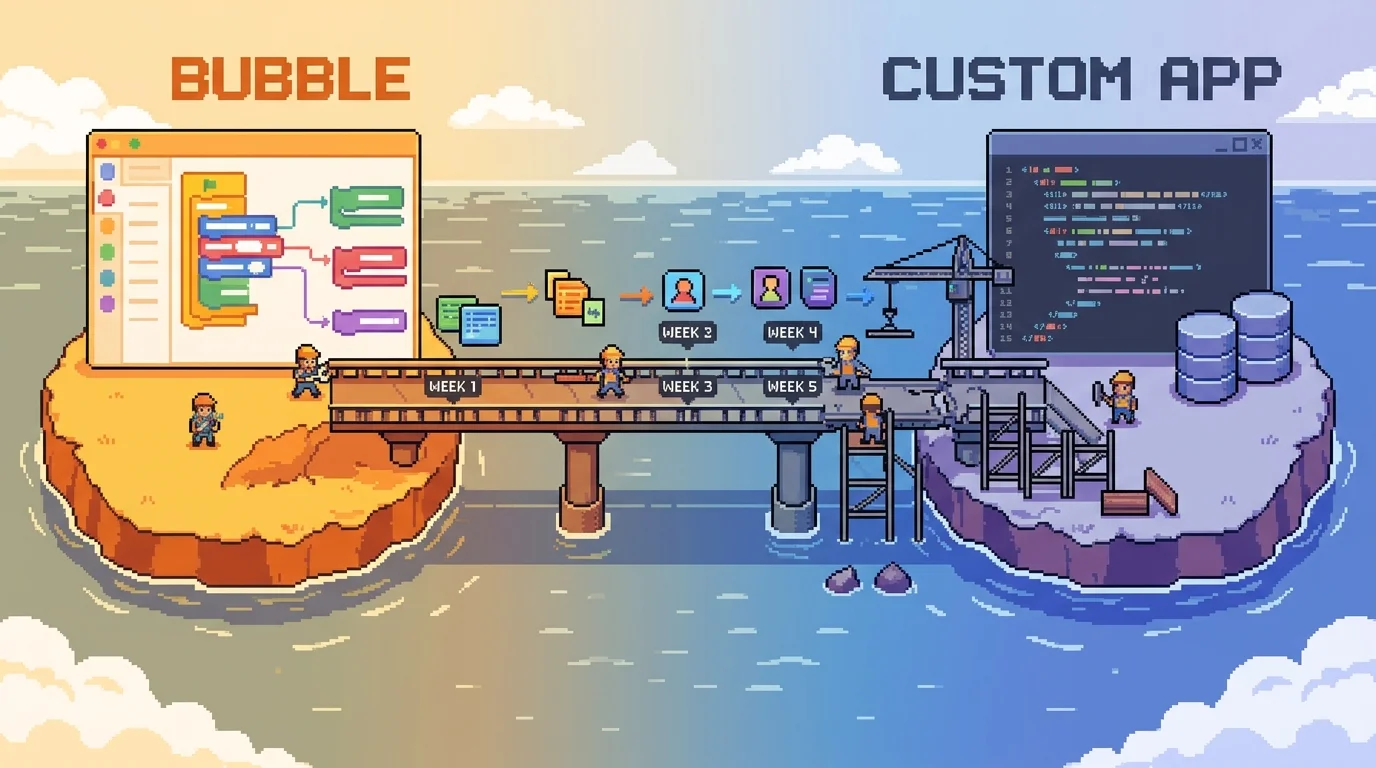
Once your custom app reaches feature parity with Bubble on core functionality, run both systems simultaneously. Route a percentage of users to the new app while keeping the majority on Bubble. This parallel running period typically lasts 2–8 weeks and serves as your real-world stress test.
During this window, you're not just checking if features work—you're validating performance under actual user load, catching edge cases your testing missed, and building confidence in data synchronization. Users experience no disruption because they don't know a migration is happening. If something breaks in the new app, users automatically fall back to Bubble. This safety net is worth the cost of maintaining both systems temporarily.
The gradual switchover also protects your team from the "big bang" failure scenario. Instead of migrating all users at once and discovering a critical bug affecting thousands, you catch issues with dozens first. Each week, increase the percentage of traffic routed to the custom app—20%, then 50%, then 80%—until you're confident enough to go 100%.
This phased approach adds 4–8 weeks to your timeline but typically saves 2–3x that in avoided crisis management, emergency fixes, and user churn. When you're ready to fully decommission Bubble, you'll do so with zero drama because your custom app has already proven itself in production.
Bubble vs. Custom Development: Long-Term Cost Comparison
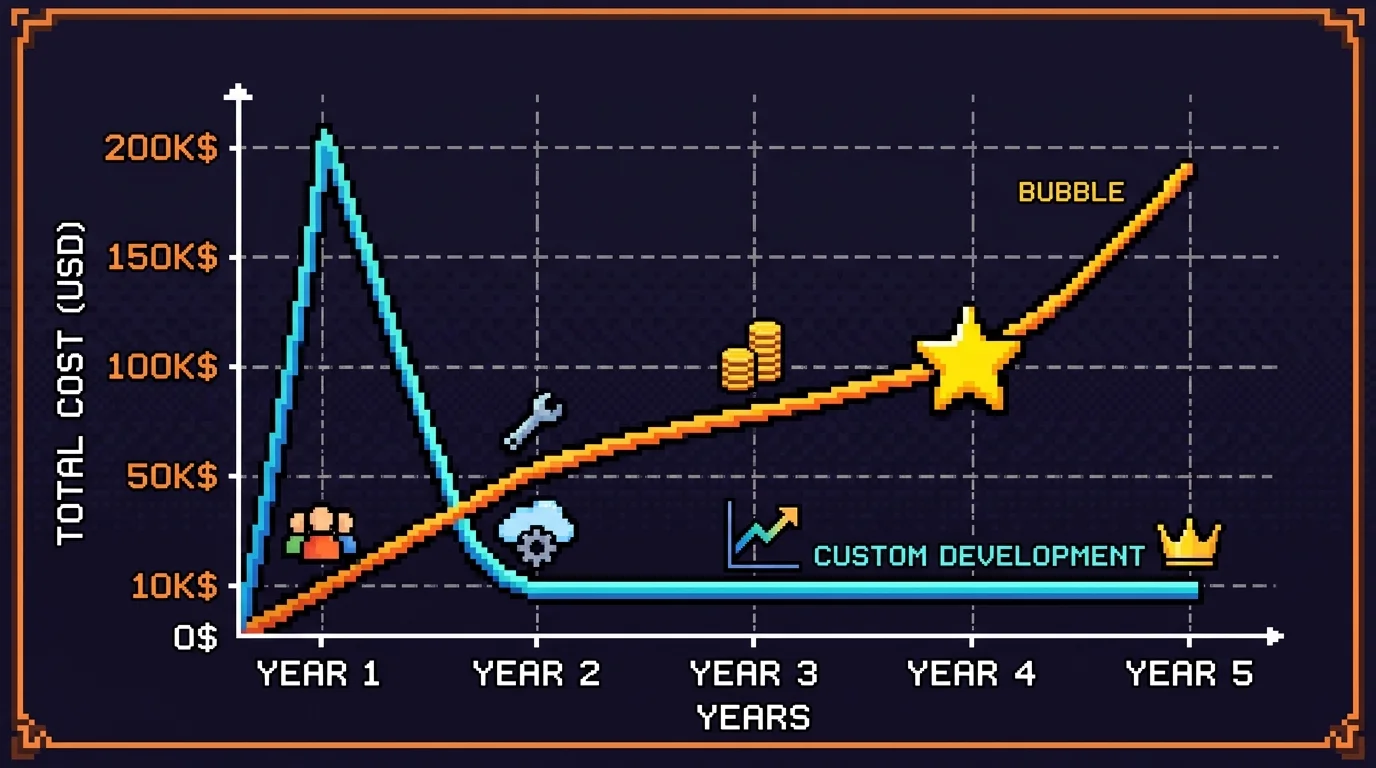
The financial case for migrating from Bubble shifts dramatically when you zoom out to a three-year horizon. While Bubble feels cheap upfront—$25 to $529 monthly depending on your plan—the true cost of ownership tells a different story as your application scales.
Bubble's pricing model is consumption-based. As your user base grows, so do your workload units. A modest app serving 500 active users might cost $200 monthly. At 5,000 users, you're paying $800–$1,200. By 10,000 users, you're looking at $2,000+ monthly. Over three years with typical startup growth, that's $50,000–$100,000 in subscription costs alone—before hosting, third-party integrations, or custom plugins that add another 20–30% to your bill.
Custom development, by contrast, carries a higher initial investment but flattens dramatically afterward. A production-ready custom application typically costs $150,000–$300,000 to build, with annual maintenance running $50,000–$100,000. That sounds steep until you compare the total cost of ownership. According to research from Kissflow, no-code platforms show 40–60% lower TCO over five years for standard business applications—but custom development becomes competitive when technical requirements intensify or user bases scale significantly.
Metric
Bubble (Year 3)
Custom App (Year 3)
Initial development
$0
$200,000
Monthly subscription (avg)
$1,200
$0
Annual maintenance
$0
$75,000
Hosting & infrastructure
$200–500/mo
$500–1,500/mo
3-Year Total
~$80,000
~$350,000
Break-even point
—
Year 4–5
The break-even happens around year four or five, depending on your growth rate. But the real advantage emerges after that inflection point. Custom apps have predictable, linear costs. Bubble's costs accelerate with scale. A startup hitting 50,000 users might pay $5,000–$8,000 monthly on Bubble—$180,000 annually—while the custom app's maintenance remains stable.
Beyond financials, custom development eliminates vendor lock-in and performance bottlenecks that plague Bubble at scale. You own the code, control the infrastructure, and can optimize without waiting for platform updates. When deciding whether to migrate, compare not just year-one costs but your realistic user projections through year three and beyond.
Avoiding Migration Pitfalls: What Startups Get Wrong
Migrating from Bubble to a custom app often fails due to preventable oversights. Startups underestimate data complexity, assuming a direct transfer is possible—yet legacy workflows embedded in no-code logic rarely map cleanly to scalable architectures. Poor planning leads to incomplete feature parity, where core functionality like user roles or payment flows breaks post-launch. According to a recent Experian study via Medium, 83% of data migrations fail or exceed budgets, highlighting the need for meticulous scoping.
Choosing inexperienced developers amplifies risk, especially when they promise to "keep no code" while rebuilding critical systems. In reality, 78% of advanced low-code projects eventually require full rewrites for integrations or business logic, often costing more than building custom from the start. Many founders skip rigorous testing phases, only to face downtime or data loss during cutover.
To avoid these issues: audit all Bubble workflows and data relationships early, prioritize architectural scalability over speed, and enforce strict test coverage. If you're moving from a spreadsheet-driven process or replacing Google Sheets with a customer portal, treat the migration as a full product rebuild—not just a tech swap. For guidance on replacing manual tools with robust internal systems, see our complete guide to building internal tools for startups.
Making the Migration Decision: Is Custom Development Right for Your Startup?
The inflection point arrives quietly. Your Bubble app hits $5,000 per month in platform costs. Performance slows. Your roadmap demands features Bubble's architecture can't deliver cleanly. At this moment, the financial and technical case for migration becomes impossible to ignore.
Migration makes sense when three conditions align: your monthly Bubble spend consistently exceeds $5,000, your user base approaches or exceeds 5,000 active users, and you need strict performance SLAs or compliance requirements Bubble can't guarantee. If you're scaling a startup on Bubble, staying puts you on a treadmill where each new feature compounds technical debt.
Conversely, stay on Bubble if you're validating a concept, your user base remains under 1,000, and your growth trajectory is uncertain. The speed-to-market advantage still favors no-code at early stages.
For founders ready to move, the decision hinges on partnership quality. A technical co-founder alternative like Shipkit eliminates the hiring risk and long ramp-up time of building an in-house team. You get a production-ready custom app with full code ownership, integrated payments, user management, and business logic—delivered in weeks at a fixed price. No surprises. No technical debt inherited from your previous platform.
The real question isn't whether migration is possible. It's whether you're choosing a partner who understands your constraints as a founder and delivers predictability alongside quality.
Article FAQ
Practical next steps
Who is this startup guide for?
This guide is written for non-technical founders, operators, and small teams who need to make product decisions before hiring a full engineering team. It focuses on practical scope, cost, timeline, and execution trade-offs rather than abstract startup theory.
What should I do after reading this article?
Turn the idea into a small decision: validate the riskiest assumption, estimate the build scope, and decide whether the first version should be no-code, custom code, or a hybrid. Shipkit's free estimate and MVP scope builder can help you translate the article into a concrete plan.
Can Shipkit help implement this kind of product?
Yes. Shipkit helps founders turn validated ideas into fixed-scope MVPs, SaaS products, internal tools, marketplaces, and AI-enabled workflows. The best starting point is to get an estimate or compare your build path before committing budget.