How Much Does MVP Development Cost for Non-Technical Founders in 2026?
Alex
··13 min read
Most non-technical founders assume MVP development costs a fortune—or they wildly underestimate what production-ready actually means. The truth lands somewhere in between, and understanding where depends entirely on what you're building, who builds it, and what "done" looks like for your specific product.
The uncertainty around MVP costs stems from a real problem: there's no standard pricing model. A simple web app costs vastly different from a marketplace or AI-powered tool. Add in variables like geographic location of your development team, feature complexity, and whether you need integrations (payments, user management, third-party APIs), and the price range becomes nearly impossible to pin down without talking to actual builders.
This article breaks down the real costs you'll face in 2026, what drives those numbers up or down, and most importantly—how to get a production-ready product without breaking the bank or making costly assumptions about what you actually need to build first.
Quick Answer: Non-technical founders typically spend $10,000–$50,000 for a functional MVP with core features, depending on complexity and team location. The cheapest way to build a production-ready MVP is choosing between fixed-price development agencies (predictable costs, no surprises) or no-code platforms (lower initial spend, but limited scalability). Most founders benefit from starting with a clear feature specification and understanding that "MVP" doesn't mean "minimum features"—it means features that prove your core business model works.
What determines your actual cost? Whether you're comparing agency vs. freelancer pricing, considering the scope creep that kills budgets, or trying to figure out if you should validate your idea first with a landing page or prototype—we'll cover the frameworks that help you make these decisions confidently. You'll also discover why some founders spend $5,000 and ship in weeks, while others spend $100,000+ and still aren't live. The difference isn't luck; it's how they defined their scope and chose their build partner.
Table of Contents
For 2026 price ranges by complexity tier, see our full MVP development cost guide.
MVP Cost Breakdown by Complexity Level: What You'll Actually Spend
Understanding where your budget goes starts with honest assessment of scope. Most founders underestimate complexity, which is why three clear tiers help you self-identify where your project actually lands—not where you hope it lands.
A simple MVP solves one core problem exceptionally well. Think: a task management tool for freelancers, a booking system for service providers, or a lead capture platform for agencies. These projects typically include user authentication, a database, and 3–5 core features. You can build in 4 weeks what founders often assume takes months.
What fits here: basic CRUD operations (create, read, update, delete), straightforward workflows, standard payment processing, and email notifications. No real-time features, no complex reporting, no multi-tenant complexity. The constraint isn't capability—it's scope discipline. Most founders at this level succeed because they've ruthlessly cut features to what actually proves their business model works.
Medium MVPs ($25,000–$50,000)
Medium complexity enters when you need multiple interconnected features or when your users have varied workflows. A marketplace MVP with vendor management and payment splitting, a SaaS tool with team collaboration, or an AI-assisted app with custom integrations typically lands here. Timeline stretches to 6–10 weeks because you're managing more moving parts: user roles, data relationships, third-party APIs, and often subscription billing.
According to research on development costs, AI-powered features add 15–30% to budgets due to data preparation and model guardrails. If you're building an AI MVP, expect the upper range of this tier. What you can build in this window: sophisticated search, reporting dashboards, webhook integrations, role-based access control, and basic automation. The difference from simple is architectural—you're designing for scalability, not just functionality.
Complex MVPs ($50,000–$100,000+)
Complex projects involve real-time features, advanced data processing, or highly integrated ecosystems. A marketplace with vendor analytics and dynamic pricing, a collaboration platform with live editing, or an AI system requiring custom model training falls here. Development stretches 10–16 weeks, and costs scale with infrastructure, data pipeline complexity, and integration depth.
These projects demand careful specification upfront because scope creep becomes expensive. You're not just building features—you're building systems. The good news: if you're at this tier, you likely have customer validation and revenue assumptions that justify the investment. The risk isn't whether to build; it's whether you've truly defined what "done" looks like before development starts.
The real cost driver isn't complexity tier—it's how clearly you've specified your scope. A founder who spends two weeks writing a detailed feature spec before development often ships faster and cheaper than one who starts building and discovers requirements mid-sprint. When you choose an agency for MVP development, fixed-price models force this clarity upfront, which is why they protect your budget.
Hidden Costs Non-Technical Founders Forget to Budget For
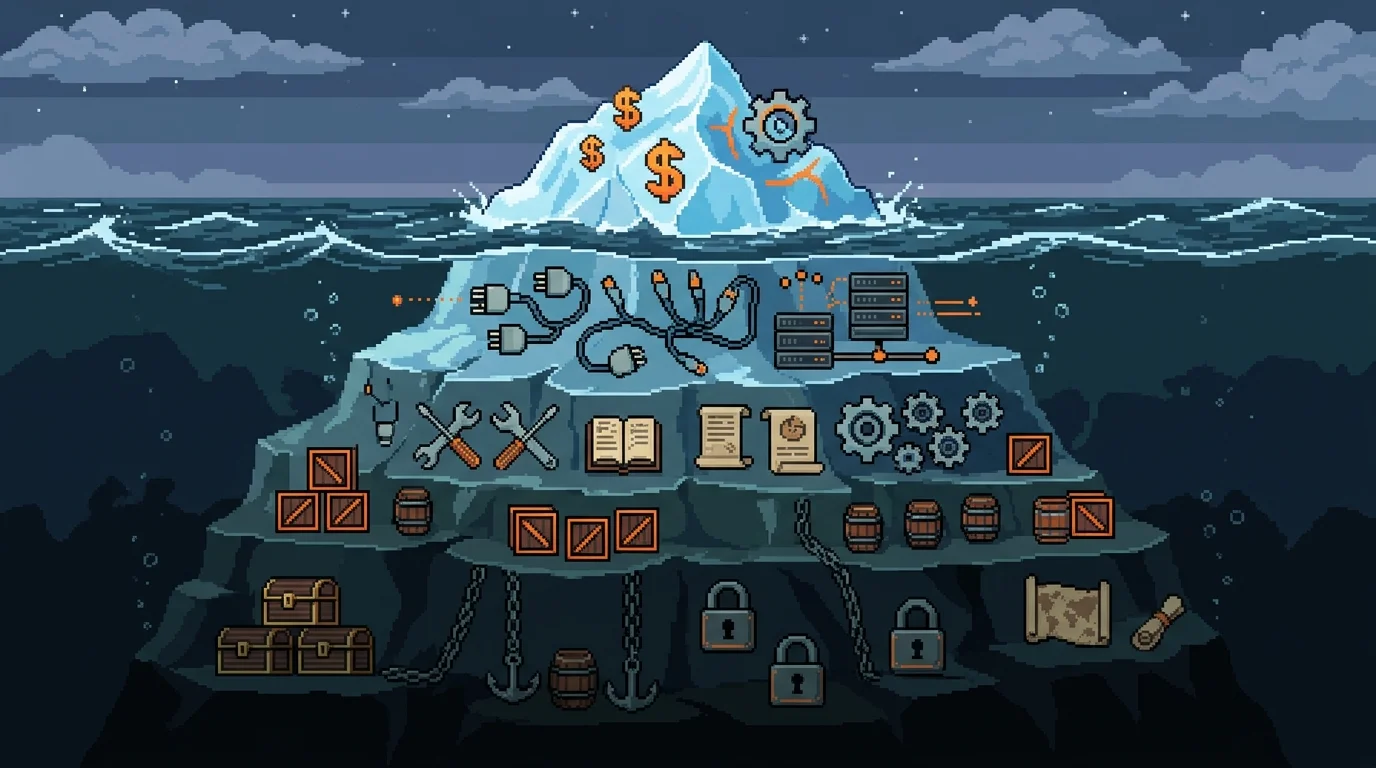
Most founders budget for development and think they're done. In reality, the code is only the beginning. The expenses that derail budgets arrive after the first sprint closes—and they're often larger than anyone anticipated.
Third-party integrations are the first silent killer. Payment processing alone isn't free: Stripe charges 2.9% + $0.30 per transaction for standard US card payments, with international cards adding an extra 1.5% fee. Beyond payments, you'll integrate authentication (Auth0, Firebase), email delivery (SendGrid, Mailgun), analytics, and CRM tools. Each integration typically costs $500–$3,000 in development time, and most MVPs require 3–5 integrations. That's $1,500–$15,000 in integration costs alone—costs many founders never see coming.
Post-launch maintenance and bug fixes compound the problem. According to research on MVP development practices, post-launch maintenance typically adds 15–20% of the initial development cost annually, covering security patches, compatibility updates, and critical bug fixes. If your MVP costs $30,000, expect $4,500–$6,000 per year just to keep it running safely. Hidden iterations and new features can add 30–40% to your original budget in the first year.
Deployment, hosting, and DevOps infrastructure costs vary wildly. A simple web app on AWS or Heroku might cost $50–$200 monthly, but a scaled SaaS with databases, CDNs, and auto-scaling can hit $500–$2,000+ monthly within months of launch. These costs grow with your user base—a problem that's actually good, but one that surprises founders who budgeted flat infrastructure costs.
Design beyond wireframes often gets underestimated. A fixed-price MVP development model forces clarity on scope upfront, but design refinement—UI polish, responsive mobile optimization, accessibility compliance—frequently requires additional investment beyond the initial spec.
Legal and compliance costs (privacy policies, terms of service, data protection, payment processing compliance) typically run $1,000–$5,000 depending on your industry and geography.
Create an MVP budget checklist for founders that accounts for these hidden layers. The difference between a $20,000 development quote and a $35,000 total cost isn't scope creep—it's reality.
How to Scope Your MVP to Stay Under Budget Without Sacrificing Quality
Smart scoping isn't about cutting corners—it's about ruthless prioritization. The difference between a $20,000 MVP and a $50,000 one often comes down to feature discipline, not development quality. Non-technical founders who nail their scope upfront launch faster, iterate cheaper, and reduce the risk of building something nobody wants.
Start with the MoSCoW method. Divide your feature list into four categories: Must-have (core functionality that defines your product), Should-have (important but not launch-critical), Could-have (nice-to-have polish), and Won't-have (explicitly out of scope). Most founders pack their Must-have list with 15+ features when a production-ready MVP needs 3–5. A marketplace MVP doesn't need advanced search filters on day one. A SaaS tool doesn't need white-label customization at launch. Be honest about what solves the core problem versus what you think users want. This single discipline cuts development time by 30–40%.
Choose your development approach strategically. Fixed-price development forces clarity upfront—you and your builder agree on exact scope before work begins, eliminating scope creep and surprise costs. Hourly development offers flexibility but invites budget drift. For non-technical founders, fixed-price models (like those offered by agencies specializing in MVP development) provide predictability and accountability. You know the final cost before the first line of code is written.
Leverage no-code and low-code where it makes sense. According to research from Gartner, businesses using low-code and no-code platforms delivered MVPs 50–70% faster with cost reductions of 50–65% compared to traditional development. Tools like Bubble, Zapier, and Make can handle workflows, automations, and integrations that would otherwise require custom code. The trade-off: these platforms work best for specific use cases (internal tools, marketplaces, simple SaaS) and may require migration later as you scale. Use them to validate demand, not to avoid building a real product.
Incorporate AI-assisted rapid builds. Modern development workflows compress timelines by 40–60% when teams use AI coding assistants effectively. Pre-trained AI models reduce custom AI feature costs by 60–80%—you're leveraging research already funded by OpenAI or Google rather than training from scratch. This doesn't mean your MVP is AI-generated; it means your developers move faster, iterate quicker, and spend less time on boilerplate code.
Define "production-ready" clearly. Many founders assume cheaper equals cutting security, performance, or reliability. It doesn't. Production-ready means your app handles real users, processes payments safely, and stays online. It doesn't mean perfect UI, advanced analytics, or every edge case handled. Agree with your builder on what "done" looks like before work starts. This prevents the $35,000 total cost surprise when you thought you were paying $20,000.
The best-scoped MVPs aren't the cheapest—they're the ones that launch on time, solve a real problem, and leave room in the budget for the iterations that actually matter.
Regional Pricing: Where to Build Your MVP and What It Costs
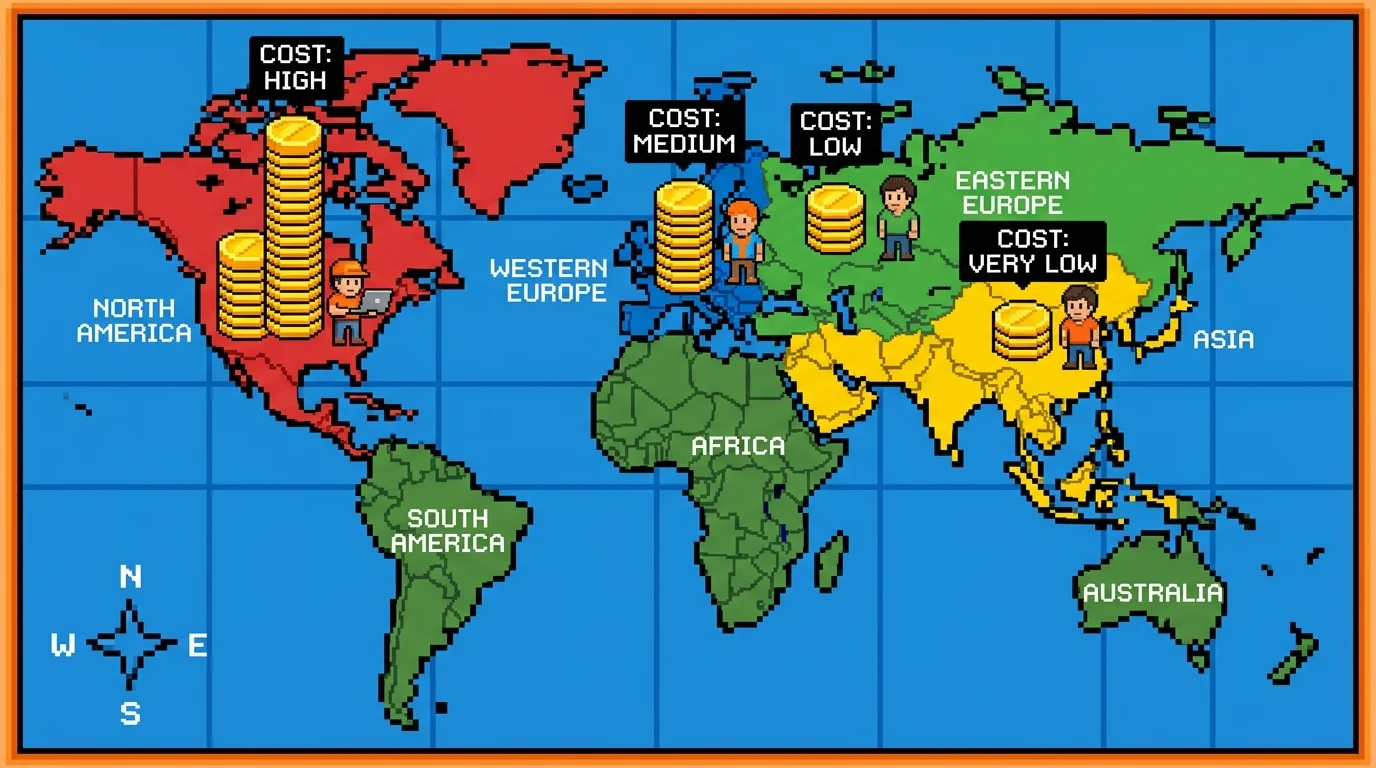
Where you build your MVP dramatically affects both cost and execution speed. Hourly rates vary wildly by geography, but the cheapest option isn't always the smartest choice for non-technical founders who need reliable delivery and clear communication.
According to research on development outsourcing costs, senior engineers in Ukraine average $40–$55/hr compared to $100+/hr in the US—a 50–60% savings without sacrificing quality. Eastern European teams can reduce MVP costs by 30–50% while maintaining production-ready standards.
The real decision isn't "which region is cheapest"—it's "what can I afford to lose?" Timezone misalignment costs communication overhead. A 12-hour gap with Asia means slower feedback loops and longer iteration cycles. A 6-hour gap with Eastern Europe is manageable for founders willing to adjust their schedule slightly.
Fixed-price MVP development contracts (common with agencies in all regions) shift risk away from hourly rate shopping entirely. You pay one price for a defined scope, regardless of whether the team is in Toronto or Tbilisi. This removes the "which region?" calculation and forces clarity on what "done" actually means.
For non-technical founders, the sweet spot is usually Eastern Europe or selective North American shops with transparent pricing. You get strong technical execution, reasonable costs, and timezone overlap that doesn't require you to work at 2 AM.
Real-World MVP Cost Examples: SaaS, Marketplaces, and AI Tools
A $25K internal SaaS tool is usually a 4–6 week build. Roughly half the budget goes to core app development (data model, workflows, basic reporting), 20–25% to authentication, permissions, and integrations (e.g., Stripe, HubSpot), and the rest to UX polish, testing, and deployment. Internal tool development cost stays contained when you reuse standard layouts and avoid complex analytics; scope creeps fast once you add custom reporting or multi-tenant architecture. If you're upgrading from spreadsheets, this is where a roadmap like the one in the guide on migrating from Airtable to a custom app becomes invaluable.
A marketplace MVP around $50K usually runs 6–10 weeks because you're effectively building for two user types. Expect ~40% of budget for core flows (listings, search, messaging), 25–30% for onboarding and KYC, payouts, and dispute flows, and the rest for admin tools, analytics, and infrastructure. The marketplace MVP cost breakdown shifts dramatically if you insist on real-time bidding, complex recommendation engines, or multi-region tax logic in version one.
An AI document assistant at $35K typically takes 5–7 weeks. About a third of the budget goes to ingestion pipelines (uploading, parsing, and storing documents), another third to integrating LLMs and prompt orchestration, and the remainder to UX, permissions, and monitoring. How much it costs to build an AI MVP like this depends heavily on whether you fine-tune models or lean on off-the-shelf APIs, as covered in the playbook on building a document Q&A app for business.
A client portal around $18K is usually a 3–4 week effort when you stick to essentials: secure login, basic dashboards, document sharing, and ticket/status views. Client portal development cost stays under control when you avoid custom theming per customer, deep multi-system integrations, or granular role hierarchies in the first release.
Essential Questions Non-Technical Founders Ask About MVP Costs
Do I need a technical co-founder? No. A technical co-founder brings equity dilution, partnership complexity, and slow decision-making. If you have capital or can raise it, outsourcing development to an agency or experienced freelancer gives you faster execution, full code ownership, and no messy cap table negotiations. The real question isn't whether you need one—it's whether the cost of hiring external help fits your runway.
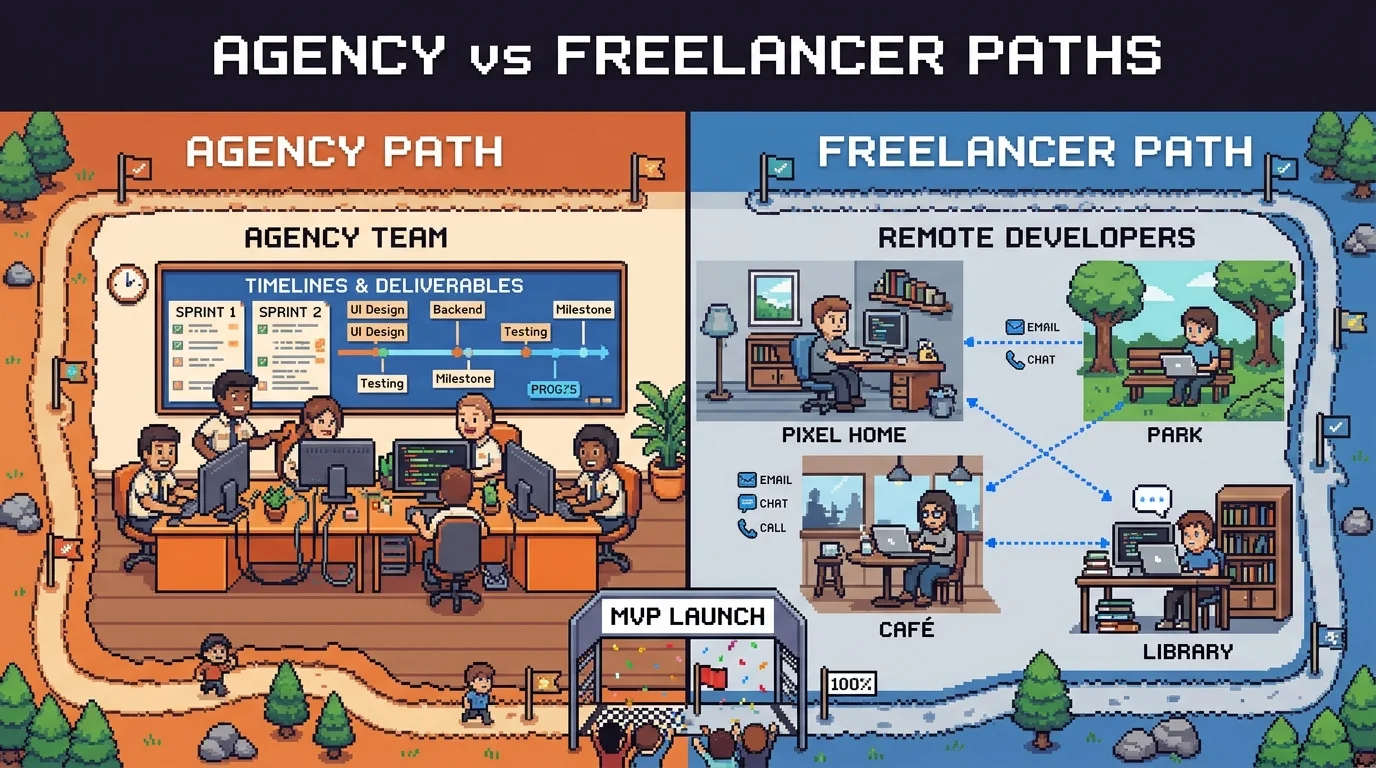
Should I use an agency or freelancers? Agencies provide accountability, fixed timelines, and integrated services (design, backend, deployment). Freelancers cost less but require you to manage scope creep, coordinate multiple people, and handle integration gaps. For non-technical founders, choosing between an agency and freelancer for MVP development depends on your tolerance for project management overhead. If you have zero technical background, an agency absorbs that burden.
What's the difference between a prototype and an MVP cost-wise? A prototype proves concept ($3K–$8K, 2–3 weeks). An MVP is production-ready with real user data, payments, and infrastructure ($15K–$50K, 4–8 weeks). The app prototype vs MVP cost difference isn't just features—it's reliability, scalability, and the ability to handle actual traffic without crashing.
How much should I budget for year one? Beyond development, add 20–30% for hosting, monitoring, customer support tools, and bug fixes. An MVP budget checklist for founders should include post-launch iteration, not just the initial build.
When is my MVP done? When it solves one core problem for your first 50 users without major bugs. Perfectionism kills startups. Ship when it works, not when it's polished.
How do I evaluate developer quotes? Red flags: vague timelines, unclear scope definitions, and promises to "add features later." Ask for a detailed breakdown of what's included, weekly deliverables, and how changes are priced. Per CB Insights' 2026 analysis, 43% of startups fail due to poor product-market fit—meaning your MVP must launch quickly to validate assumptions, not sit in development limbo while scope expands.
Article FAQ
Practical next steps
Who is this MVP guide for?
This guide is written for non-technical founders, operators, and small teams who need to make product decisions before hiring a full engineering team. It focuses on practical scope, cost, timeline, and execution trade-offs rather than abstract startup theory.
What should I do after reading this article?
Turn the idea into a small decision: validate the riskiest assumption, estimate the build scope, and decide whether the first version should be no-code, custom code, or a hybrid. Shipkit's free estimate and MVP scope builder can help you translate the article into a concrete plan.
Can Shipkit help implement this kind of product?
Yes. Shipkit helps founders turn validated ideas into fixed-scope MVPs, SaaS products, internal tools, marketplaces, and AI-enabled workflows. The best starting point is to get an estimate or compare your build path before committing budget.