How to Build a SaaS Product with Lovable: The Complete Guide for Non-Technical Founders
Alex
··16 min read
The landscape of SaaS development has fundamentally shifted. What once required hiring a technical co-founder, assembling an engineering team, or spending six figures on custom development can now happen in weeks with tools that let non-technical founders actually build. When you build SaaS with Lovable—or leverage similar AI-powered development platforms—you're tapping into a paradigm where artificial intelligence handles the complexity of coding while you maintain complete creative and strategic control.
This isn't about low-code drag-and-drop builders that lock you into proprietary platforms. It's about AI cofounder tools for startup founders that generate production-ready code you own outright, complete with payment integrations, user authentication, and real business logic. The speed advantage is staggering: according to RapidNative research, startups using AI-assisted tools are launching functional MVPs in just 2 to 6 weeks—roughly 10 times faster than traditional development timelines.
Quick Answer: Building SaaS with Lovable means using AI to generate production-ready applications from natural language specifications, enabling non-technical founders to ship functional products in weeks instead of months. You own the code, control the roadmap, and skip the traditional hiring and management overhead—making it one of the best AI app builders for founders who want speed without surrendering ownership.
This guide walks you through why this shift matters, how the process actually works, and what separates genuine AI-powered development from overhyped no-code platforms. You'll discover how to build an AI MVP without coding, what to expect from the timeline and cost structure, and how to evaluate whether this path fits your specific product and market.
What Is Lovable and How Does It Compare to Other AI Development Tools?
Lovable is an AI-powered code generation platform that transforms natural language specifications into production-ready SaaS applications. Rather than generating UI mockups or prototypes, Lovable produces actual, deployable code that founders own outright from day one. You describe what you want to build—your features, workflows, integrations—and the platform generates a functional application complete with backend logic, database schemas, and API endpoints. This fundamental difference separates Lovable from traditional no-code platforms and positions it as a genuine alternative to hiring developers or assembling a technical team.
The platform has achieved significant traction: according to Tailkits research, Lovable surpassed 2.3 million monthly active users with 180,000 paying subscribers and $75 million in annual recurring revenue. More importantly for founders evaluating the tool, Lovable's recent switch to Claude 4 delivered approximately 25% fewer errors and 40% faster prompt execution, while maintaining 20× faster app building compared with hand-coding.
Why Lovable Wins for SaaS Over No-Code Platforms
Traditional no-code tools like Bubble and FlutterFlow excel at rapid prototyping and simple applications, but they hit hard ceilings when you're building serious SaaS products. These platforms lock you into their proprietary ecosystems—you cannot migrate your application to custom infrastructure, you depend on their pricing and uptime, and you cannot implement custom business logic beyond what the platform permits. Roughly 25 to 30 percent of no-code SaaS projects get rewritten in custom code within two years due to performance limits, scalability walls, and feature ceilings, according to Design Revision research.
Lovable sidesteps this trap entirely. Because you receive actual code—not a locked-in application—you own the entire stack from day one. You can deploy to your own cloud infrastructure, customize any feature without platform constraints, and scale without hitting artificial limits. For founders building subscription products, marketplaces, or any application requiring deep customization, this code ownership model is non-negotiable.
The Key Difference: Prototype vs. Production-Ready Code
The distinction between AI prototyping tools and Lovable's approach matters enormously. Tools like Bolt generate interactive UI prototypes that demonstrate what an app could look like but lack the backend infrastructure, database design, and business logic required for a real product. They're excellent for visualizing concepts; they're insufficient for launching.
Lovable generates code that is immediately deployable. Your application includes authentication systems, database models, API routes, and integration hooks—everything needed to accept real users and process real transactions. This doesn't mean the code is perfect or requires zero refinement; it means you're starting with a functional foundation, not a mockup that needs to be rebuilt from scratch. For founders evaluating whether to use Lovable versus alternatives like Cursor (which requires coding knowledge to guide the AI), Lovable removes the technical barrier entirely by handling code generation without requiring you to write or understand the underlying implementation.
Platform
Output Type
Code Ownership
Best For
Learning Curve
Lovable
Production-ready code
Full ownership
SaaS MVPs, subscription products
Non-technical founders
Bolt
Interactive prototypes
Platform-dependent
UI/UX visualization, demos
Designers, quick mockups
Cursor
Code with AI assistance
Full ownership
Developers building custom apps
Technical founders, engineers
Bubble
No-code applications
Platform-dependent
Simple apps, internal tools
Non-technical, limited scale
The Step-by-Step Process: From Idea to Deployed SaaS with Lovable
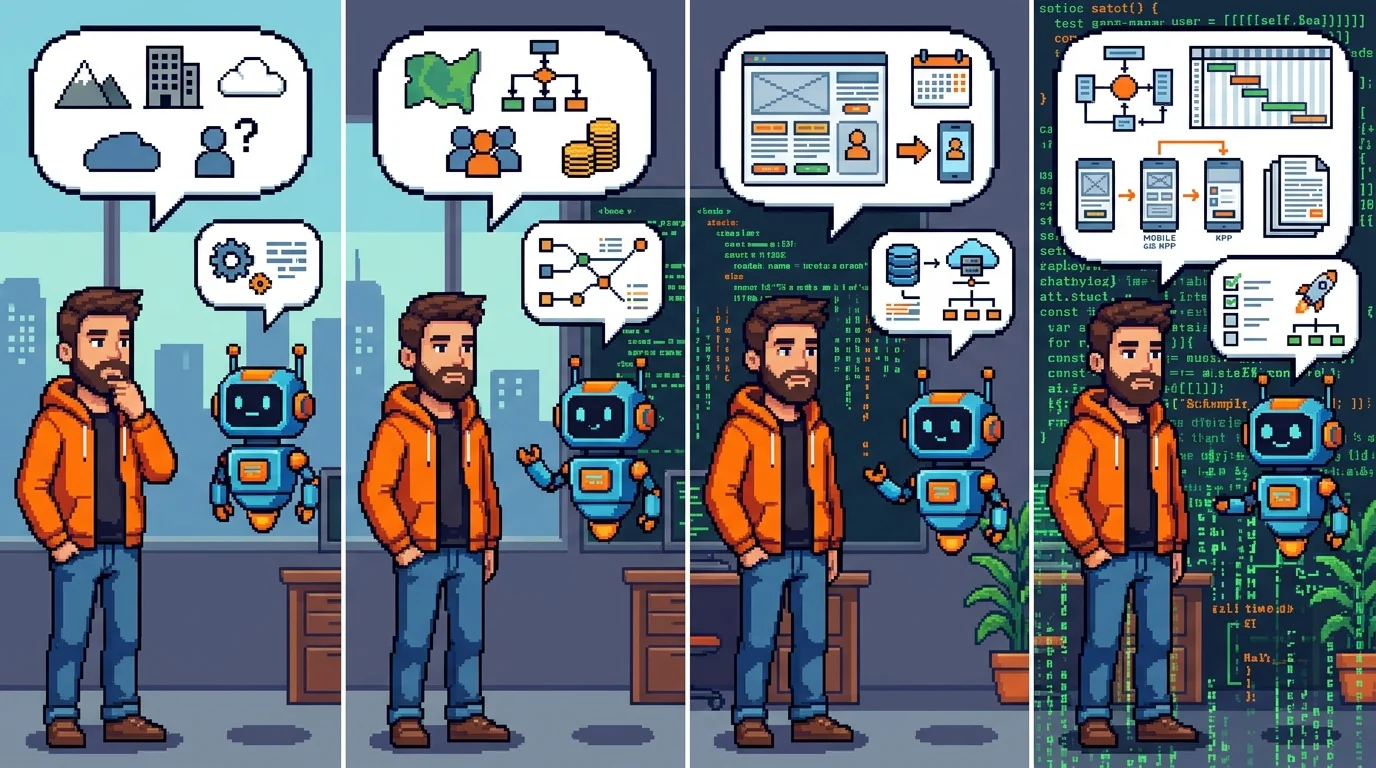
Building a SaaS product with Lovable follows a structured workflow that transforms vague ideas into deployed applications. The key difference from traditional development is that founders guide the AI through clear, discrete prompts rather than managing developers or writing code themselves. This process typically unfolds across six interconnected phases, each designed to move you from concept to production-ready software.
Step 1: Write a Bulletproof Specification for Lovable
Your specification document is the foundation of everything Lovable generates. Vague prompts produce vague results—a specification like "build a dashboard" will fail, while "create a dashboard showing active user count, revenue this month, and churn rate in three separate cards with real-time updates from the database" succeeds. Lovable's AI needs specificity to understand your intent.
Break your SaaS into small, discrete tasks rather than large features. Instead of "build user authentication," specify: "create a login page with email and password fields, validate email format, hash passwords using bcrypt, store user data in a PostgreSQL table with id, email, password_hash, and created_at columns." This level of detail—what fields exist, how data flows, what validation rules apply—is what Lovable's AI uses to generate functional code.
A bulletproof spec includes: core user flows (how users move through your app), data models (what information you store and how it relates), UI requirements (what pages exist and what they display), and integrations (payment processors, email services, APIs). Write this as a bulleted outline, not prose. Reference specific UI elements: "On the dashboard, below the revenue card, add an 'Export to CSV' button that downloads the last 30 days of transactions."
Step 2-3: Set Up Your Workspace and Define MVP Scope
Create a Lovable project and organize your prompts into a library—one prompt per small feature or task. This prevents confusion and lets you iterate on individual components without regenerating your entire app. Name prompts clearly: "User signup with email validation" rather than "auth stuff."
MVP scope is where founders often stumble. Your first version should include only the core value proposition—the one thing users will pay for or use repeatedly. If you're building a scheduling SaaS, your MVP needs: user accounts, the ability to create and view events, and email reminders. Defer: recurring events, calendar integrations, team collaboration, and advanced analytics. These belong in version 1.1 or 2.0. A lean scope means you deploy faster, gather real user feedback, and avoid building features nobody wants. According to No Code MBA, a SaaS dashboard with user authentication, Stripe subscriptions, and an admin panel can be built in approximately 4 hours using Lovable.
Step 4-6: Generate, Test, and Deploy Your SaaS
Start with authentication. Prompt Lovable to build user signup and login with email/password, then test locally by creating test accounts. Once authentication works, move to your core feature—the reason users exist. Build iteratively: one feature per prompt, test it, then move to the next.
Testing happens in Lovable's preview environment before deployment. Create test data, walk through user flows, and verify that buttons work and data saves correctly. When you're confident, deploy to production. Lovable generates code you own completely—deploy to Vercel, AWS, or any cloud provider. Integrate Stripe for payments by prompting Lovable to add a subscription checkout page and webhook handlers that update user status when payments succeed.
The entire workflow—from spec to deployed SaaS with payments—typically takes 2-4 weeks depending on complexity. You're not waiting for developers or managing technical debt; you're iterating on prompts and refining your product based on what actually works.
Best Practices and Common Mistakes When Building SaaS with Lovable
Master the Art of Prompting for SaaS Features
The difference between a successful Lovable build and a frustrating one often comes down to prompt precision. Vague instructions produce vague results. "Add a user dashboard" might generate something functional, but it won't match your vision. Instead, think like a technical specification writer: "Add a dashboard page showing all active users in a table with columns for name, email, signup date, and account status. Include a delete button in the last column that removes the user after confirmation."
Specificity wins. Reference exact UI elements, describe data structure, and clarify user flows. Rather than "integrate payments," say "add a subscription checkout page with monthly and annual pricing options, display the selected plan, and create webhook handlers that update user status to 'active' when Stripe confirms payment." This level of detail tells Lovable exactly what to build, reducing back-and-forth iterations.
Good prompts also acknowledge Lovable's building blocks—components, state management, and API routes. Mention these when relevant: "Create a React component for the settings page that stores user preferences in local state, with a save button that calls the /api/user/settings endpoint." You don't need to be a developer to write this way; you're simply being explicit about what should happen and where.
Plan for Scale: When to Stop Using AI and Hire Engineers
Lovable excels at MVP velocity. You can ship a functional SaaS product with user authentication, a core feature set, and Stripe payments in 2–4 weeks. But AI-generated code has boundaries. Only about 30% of AI-suggested code gets accepted by developers without modification, and when scaling becomes critical, those gaps widen.
Lovable works best for products under 10,000 users with straightforward architecture. Once you hit complexity—advanced algorithms, high-traffic optimization, complex security requirements, or intricate third-party integrations—human engineers become essential. Similarly, if your product requires custom infrastructure, real-time performance tuning, or compliance with strict regulatory standards, you'll outgrow what AI can reliably deliver.
Think of Lovable as your founder's co-founder for the MVP phase. It gets you to product-market fit fast. When you're ready to scale beyond that, you'll hire engineers to refactor, optimize, and build the sophisticated systems your growth demands. This isn't a limitation of the tool—it's a realistic boundary that helps you allocate resources wisely.
Test Thoroughly Before Deployment
Testing in Lovable's preview environment is non-negotiable. Create realistic test data, walk through every user flow, and verify that edge cases don't break your product. Test signup with invalid emails, try deleting data, attempt payment with expired cards. The cost of finding bugs before launch is zero; the cost of discovering them in production is reputation and churn.
Document what you test and what works. This becomes your reference when you eventually hand code to engineers or need to explain behavior to users. Testing also forces you to think like your users—you'll catch UX issues that prompts alone won't reveal.
Common Mistakes to Avoid
Over-scoping your MVP. Founders often try to build too much in one pass. Resist the urge. Define your core feature—the one thing users absolutely need—and build that first. Everything else is secondary. Lovable makes iteration fast, so ship lean and add features based on real user feedback.
Ignoring code ownership. Lovable gives you complete code ownership from day one. Understand where your code lives, how to deploy it, and how to access it later. Don't treat the generated code as a black box. Review it, understand the structure, and plan for maintenance.
Failing to plan integrations early. If your SaaS needs Stripe, email, or third-party APIs, mention these in your initial prompts. Building integrations after the fact is harder than building them in. Lovable handles webhooks and API calls well when you're explicit about requirements upfront.
Real-World SaaS Examples: What Founders Have Built with Lovable
The power of Lovable becomes concrete when you see what founders have actually shipped. These aren't theoretical exercises—they're production SaaS applications built by non-technical founders who had an idea, a clear specification, and a deadline.
According to Medium documentation by Adnan Fareed, founders have built multi-tenant SaaS MVPs with authentication, dashboards, and AI-powered features in approximately 2 days. One example involved a note-taking application with graph visualization (similar to Obsidian), complete with custom domains and theming. The founder shipped it without writing a single line of code manually—Lovable generated the entire stack, and the founder deployed it live within 48 hours.
Beyond that, real-world Lovable projects include project management systems, CRM platforms, and SaaS apps with Stripe integration built by non-technical founders. One founder created a scheduling coordination tool that handles calendar conflicts, sends automated reminders, and integrates with Google Calendar—all in a single iteration. Another built an internal operations dashboard that replaced scattered spreadsheets with real-time data visualization and role-based access control.
What ties these examples together is scope discipline. None of these founders tried to build a fully-featured enterprise platform in week one. They identified their core feature—the one thing users absolutely needed—and built that first. A scheduling app didn't launch with advanced analytics; a CRM didn't ship with custom reporting. They launched lean, gathered user feedback, and iterated.
The timeline is the revelation. When you can build an AI MVP without coding and deploy it in days rather than months, you compress the feedback loop dramatically. You test assumptions faster. You learn whether your market actually exists before you've spent six figures or burned out your technical team. This speed is why Lovable has become the tool of choice for founders who want to validate quickly and maintain complete code ownership from day one.
How Shipkit Bridges the Gap: From Lovable MVP to Production SaaS
Lovable excels at one specific job: turning ideas into working prototypes fast. You describe a feature in plain language, the AI generates code, and within hours you have something clickable. For founders validating whether a market exists or testing a core assumption, this speed is invaluable. But speed and validation are not the same as a production SaaS product. The moment your MVP gains traction—users sign up, feedback arrives, payment processing becomes real—the gap between a prototype and a scalable business becomes painfully obvious.
This is where Lovable's strengths become constraints. An AI-generated MVP typically lacks the architecture for growth: payment integrations that handle refunds and disputes, user authentication systems that scale securely, database structures designed for real-world data volume, or the monitoring and error handling required when downtime costs you revenue. Lovable is designed for iteration speed, not for handling the operational complexity of a live product with paying customers.
Shipkit serves as your technical co-founder alternative when that gap appears. Rather than treating your Lovable prototype as disposable, Shipkit builds on top of it—or rebuilds from specification when necessary—to create a production-grade SaaS product with integrated payments, role-based access control, and business logic that actually survives contact with real users. You maintain 100% code ownership from day one, and the fixed-price model means you know costs upfront. The 4-week delivery timeline compresses what would traditionally take months of hiring, onboarding, and coordination into a predictable sprint.
When to Use Lovable Alone vs. When to Bring in Shipkit
Use Lovable if: You're validating a concept, learning how AI tools work, or building a prototype on a tight budget. You want to own the learning process and iterate independently. Your timeline is flexible, and you're comfortable managing technical debt as you learn.
Use Shipkit (or hire a development team) if: Your MVP has proven market fit and needs to scale. You need payment processing, user management, and compliance built correctly. You want a technical co-founder who handles the entire product lifecycle while you focus on customers and business strategy. Your timeline is fixed and non-negotiable—you need a production app in weeks, not months.
The decision isn't about which tool is "better." It's about matching your current stage to the right resource. Lovable is a founder's rapid prototyping tool. Shipkit is the engineering partner who takes that prototype and turns it into a business.
Launch Your SaaS in Weeks, Not Months: The Lovable Advantage for Founders
The barrier to entry for building SaaS has collapsed. Five years ago, launching a product meant assembling a technical team, managing hiring timelines, and burning through capital before you'd shipped a single feature. Today, non-technical founders can write a clear specification, iterate on prompts, and watch Lovable generate production-ready code in real time. This isn't prototype-grade work—it's code you can deploy to paying customers.
The core insight is simple: you no longer need to hire a CTO or spend months learning to code. If you can articulate what your product should do, you can build an AI MVP without coding by using Lovable to translate those requirements into working software. The best AI app builder for founders removes the technical gatekeeping that once made SaaS development inaccessible. You write specifications. The tool handles the implementation. You own the result.
Start small. Define your MVP scope ruthlessly—what's the absolute minimum your first users need? Write a detailed specification that describes workflows, not just features. Then test Lovable with a real project. Iterate on your prompts based on what the tool generates. Most founders find that building SaaS with Lovable for non-technical founders works best when you treat it as a conversation with an intelligent code generator, not a magic button.
If your MVP gains traction and you need payment processing, compliance, or infrastructure that scales beyond what you're comfortable managing alone, resources like Shipkit exist to bridge the gap. But the starting point is yours—and it's never been faster or cheaper to validate whether your idea actually works.
Article FAQ
Practical next steps
Who is this startup guide for?
This guide is written for non-technical founders, operators, and small teams who need to make product decisions before hiring a full engineering team. It focuses on practical scope, cost, timeline, and execution trade-offs rather than abstract startup theory.
What should I do after reading this article?
Turn the idea into a small decision: validate the riskiest assumption, estimate the build scope, and decide whether the first version should be no-code, custom code, or a hybrid. Shipkit's free estimate and MVP scope builder can help you translate the article into a concrete plan.
Can Shipkit help implement this kind of product?
Yes. Shipkit helps founders turn validated ideas into fixed-scope MVPs, SaaS products, internal tools, marketplaces, and AI-enabled workflows. The best starting point is to get an estimate or compare your build path before committing budget.