How to Choose an MVP Development Agency in San Diego
Alex
··10 min read
Hiring an agency is the largest cheque most non-technical founders write before they have a product. In San Diego you will get quotes for the same brief that differ by a factor of five, and the proposals will be written so differently that comparing them feels like guesswork. This guide is about closing that gap: what the money buys, which questions separate a product team from a body shop, and what a proposal looks like when someone intends to miss the deadline.
Quick Answer: An MVP development agency builds lean, functional versions of your product to test market fit fast—critical since 42% of startups fail due to no market need. For founders without a technical cofounder, these agencies act as a full product development partner, turning ideas into deployable apps with fixed timelines and budgets.
About this guide. It is published by Shipkit, a studio that competes for exactly this work, so it does not rank other agencies. We could not verify claims about competitors to the standard we would want applied to us, and a ranking written by a participant is worth very little anyway. What follows is the evaluation framework instead — use it on us as readily as on anyone else. For third-party listings, Clutch maintains a San Diego software developer directory. Last reviewed August 2026.
What Modern MVP Development Agencies Offer in 2026
Today’s top MVP development agencies go far beyond basic app creation—they function as technical co-founders, especially for non-technical entrepreneurs. In 2026, success hinges on speed, intelligence, and scalability, and leading agencies deliver full-stack solutions that include AI integration, secure payment systems, and production-ready architecture from day one.
AI and RAG-Powered MVPs for Smart Startups
AI is no longer optional. Agencies now embed generative AI features like intelligent chatbots, document Q&A, and copilot workflows directly into MVPs. Retrieval-Augmented Generation (RAG) systems are becoming standard for startups needing accurate, private AI assistants that pull from internal data—without hallucinating. по данным 2026 AI Trends Report, 84% of production AI assistants now rely on RAG. This shift makes AI MVP development service for founders a core offering, not a premium add-on.
AI and speed: The new startup advantage in San Diego’s tech scene
From Bubble to Code: Migration and Scalability Services
Many founders start with no-code tools like Bubble but hit limits as they scale. Agencies now offer structured migration paths to custom code—typically when startups approach $20K MRR and prepare for investor conversations. Converting a prototype into a scalable, maintainable codebase ensures higher valuations and smoother feature development. For teams ready to make the leap, a detailed guide on Bubble to custom app migration cost breaks down timelines and investment ranges.
Integrated Business Logic: Payments, Auth, and User Management
A true MVP isn’t just a demo—it’s a deployable product. That’s why modern agencies bake in essential infrastructure: Stripe-powered subscriptions, role-based access control, and secure user authentication. Whether building a client portal development service, internal tool development service, or marketplace MVP development service, these components ensure the app is investor-ready and operationally sound from launch.
What Separates a Product Team from a Dev Shop
Four things decide whether an outside team ships something you can raise on: technical execution, speed to a working version, how much product thinking they do for you, and whether they have built this category before. Portfolios and awards tell you almost nothing — every shop shows its three best screens. These four are visible in a proposal, before you have paid anything.
Speed to Market: What “Under 8 Weeks” Requires
Time is a startup’s scarcest resource. Most MVPs take 8–16 weeks from concept to launch, with simpler products on the lower end. The top agencies offer fixed-scope, fixed-timeline builds—the fastest delivering a narrow first version in about four weeks. This predictability allows founders to align development with fundraising cycles and market opportunities. A clear roadmap with milestone-based delivery is the signal worth paying for.
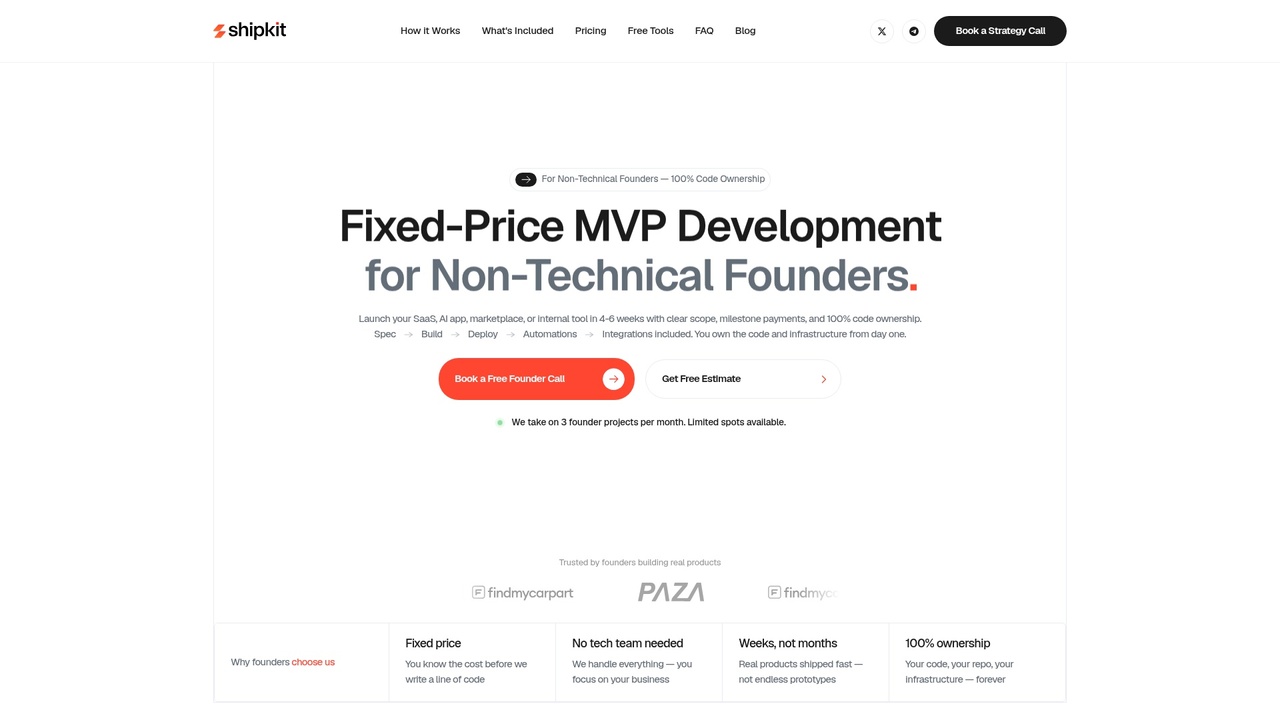
Real-world example: Shipkit’s fixed-scope, fixed-timeline MVP offering for non-technical founders
Technical Co-Founder Model vs. Traditional Outsourcing
We prioritized partners that act as true extensions of the founding team, not just code vendors. Firms offering product strategy, technical architecture, and ongoing iteration — closer to a technical co-founder — behave very differently from those selling development hours. This model reduces misalignment and accelerates decision-making, especially for non-technical founders.
Validation-First Approach: Landing Pages and Market Testing
The best agencies de-risk development by integrating validation early. Some offer a launchpad landing page validation service to test demand before writing a single line of code. This approach ensures you’re not building in isolation—and aligns with our guide on how to validate your startup idea before development. Whether you’re looking to build a web app for a service business or an AI-powered platform, validation-first builds confidence and conserves runway.
What You’ll Actually Pay in San Diego
Price is where proposals stop being comparable, because the models underneath them allocate risk differently. There are three, and the choice matters more than the headline number.
The Three Pricing Models, and What Each One Protects
Fixed price moves estimate risk onto the agency. If the build takes twice as long, that is their problem. The trade is that it only works against a scope written down in advance, so a fixed price quoted from a two-paragraph brief is not really fixed — it is an opening position.
Time and materials moves that risk onto you. It is the honest choice when the scope genuinely cannot be known yet, such as an integration against an API nobody has read. It is the expensive choice when it is used to avoid the work of scoping.
Retainer or embedded team buys continuity rather than a deliverable. It suits a product already in market with a roadmap, and suits a first version badly.
For reference points: agencies serving the US market commonly quote $150–$250 an hour, and a full first build lands somewhere between $40,000 and $100,000 — our MVP development cost guide breaks that down by feature scope. Our own published prices, disclosed because we are one of the options: $5,900 for a validation launchpad, $8,900 for a first version, $14,900 and up for a custom platform, shipped in four to six weeks.
A Scorecard for Comparing Proposals
Run every proposal through these seven questions. They are answerable from the document itself, and the pattern of answers is more informative than any single one.
Does the scope list screens and user actions, or adjectives? “Modern, scalable dashboard” is not a scope. “Admin can filter orders by status and export CSV” is.
Who writes the code? Ask for names and the hours each will spend. “Our team” frequently means a subcontractor you will never meet.
When do you get the repository? The right answer is day one, with your own account as owner. Ownership that transfers on final payment is leverage held against you.
What happens when the estimate is wrong? Every estimate is wrong somewhere. A team that has done this before will tell you what they cut first and who decides.
Can you deploy without them? If the answer involves emailing someone, you have bought a dependency rather than a product.
What is covered after launch, and for how long? Separate the bug-fix window from paid support, in writing, before you sign.
Will they give you a reference you can call? Not a logo wall — a founder, on the phone, who shipped something comparable.
Red Flags That Should Stop a Deal
None of these are unusual. All of them predict the same outcome.
A price quoted before anyone wrote down what is being built.
“We’ll work out the details during development.” The details are the project.
A timeline with one milestone: launch. Nothing is verifiable until it is too late to act.
Reluctance to name the engineers, or to let you speak to them.
A rank, badge or award with no stated methodology — including, as it happens, the earlier version of this page.
How to Choose the Right MVP Partner Without a Technical Cofounder
Selecting the right development partner is one of the most critical decisions a non-technical founder makes. The wrong fit can lead to budget overruns, missed deadlines, or a product that fails to meet market needs. The right one acts as a true extension of your vision—delivering a functional, scalable MVP with clarity and accountability.
Fixed-Price vs Time-and-Materials: Which Is Safer for Founders?
For early-stage startups, predictability is survival. A fixed-price engagement locks in scope, cost, and timeline upfront—ideal for founders who need to control burn and avoid scope creep. Time-and-materials offers flexibility but requires close oversight to prevent cost drift.
Model
Pros
Cons
Fixed-Price
Clear budget, defined timeline, lower risk of overruns
Less flexibility for mid-project changes
Time-and-Materials
Adaptable to evolving needs, better for exploratory projects
Costs can escalate without strict governance
Founders without a technical background often fare better with fixed-price contracts, especially when the MVP scope is well-defined. For insight on realistic pricing, review our breakdown of fixed-price MVP development cost in 2026.
Key Questions to Ask Before Signing a Contract
Ask these before committing:
Who owns the code and IP upon delivery?
What tech stack will you use, and why is it suitable for scaling?
Can you provide documentation and admin access post-launch?
How do you handle third-party integrations like payments or auth?
What happens if the project runs late or over budget?
These questions uncover whether the agency operates transparently—a hallmark of a true no technical cofounder product development partner.
Avoiding Costly Delays: Timeline Commitments and Milestones
Break the project into phased milestones with deliverables: wireframes, core functionality, testing, deployment. Demand weekly updates and access to staging environments. Agencies that commit to sprint reviews and clear exit criteria help you avoid common pitfalls to avoid when hiring an agency—like ghosting or indefinite delays.
Frequently Asked Questions About Hiring an MVP Development Agency in San Diego
How much does it cost to build an MVP in San Diego? A full first build from a US agency typically lands between $40,000 and $100,000, driven by feature count rather than by city. Scoped-down first versions cost far less — ours start at $5,900. The variable that moves the number most is how much you insist on shipping in version one. See the ranges by feature scope in our fixed-price MVP development guide. Can you realistically build a SaaS MVP in 4 weeks? Yes, when the scope is genuinely small and settled before work starts — that is the trade a four-week build makes. Our own fixed-scope builds run four to six weeks. Anything with a novel integration, a compliance requirement, or an undecided data model will take longer, and a team that promises otherwise has not read the brief.
Is an agency better than a freelancer? Agencies offer structured workflows, QA, and accountability—critical for non-technical founders who need end-to-end ownership without micromanaging. What about technical oversight? The best partners act as your technical co-founder, making key stack decisions while keeping you informed through sprint reviews and staging access.
Concerned about post-launch? Ensure your contract includes full code and IP ownership, admin access, and documentation. Many agencies also offer a launchpad landing page validation service to test demand pre-build. For founders starting on Bubble, a dedicated bubble migration service for founders ensures smooth scaling later. For AI-driven concepts, an AI MVP development service for founders streamlines prototyping with intelligent features without requiring ML expertise.
Launch Your Startup with Confidence in 2026
Choosing a San Diego MVP development agency isn’t just about finding coders—it’s about securing a true product development partner who acts as your technical co-founder. For non-technical startup founders, the right collaborator de-risks the journey with fixed-price models, rapid timelines, and clear ownership. For what it is worth on a page we publish ourselves: Shipkit builds fixed-scope MVPs in four to six weeks, with the repository in your account from the first commit. Skip the guesswork: explore our fixed-price MVP development guide to launch with confidence.
Article FAQ
Practical next steps
Who is this MVP guide for?
This guide is written for non-technical founders, operators, and small teams who need to make product decisions before hiring a full engineering team. It focuses on practical scope, cost, timeline, and execution trade-offs rather than abstract startup theory.
What should I do after reading this article?
Turn the idea into a small decision: validate the riskiest assumption, estimate the build scope, and decide whether the first version should be no-code, custom code, or a hybrid. Shipkit's free estimate and MVP scope builder can help you translate the article into a concrete plan.
Can Shipkit help implement this kind of product?
Yes. Shipkit helps founders turn validated ideas into fixed-scope MVPs, SaaS products, internal tools, marketplaces, and AI-enabled workflows. The best starting point is to get an estimate or compare your build path before committing budget.