Choosing Between an Agency and Freelancer for MVP Development
Alex
··11 min read
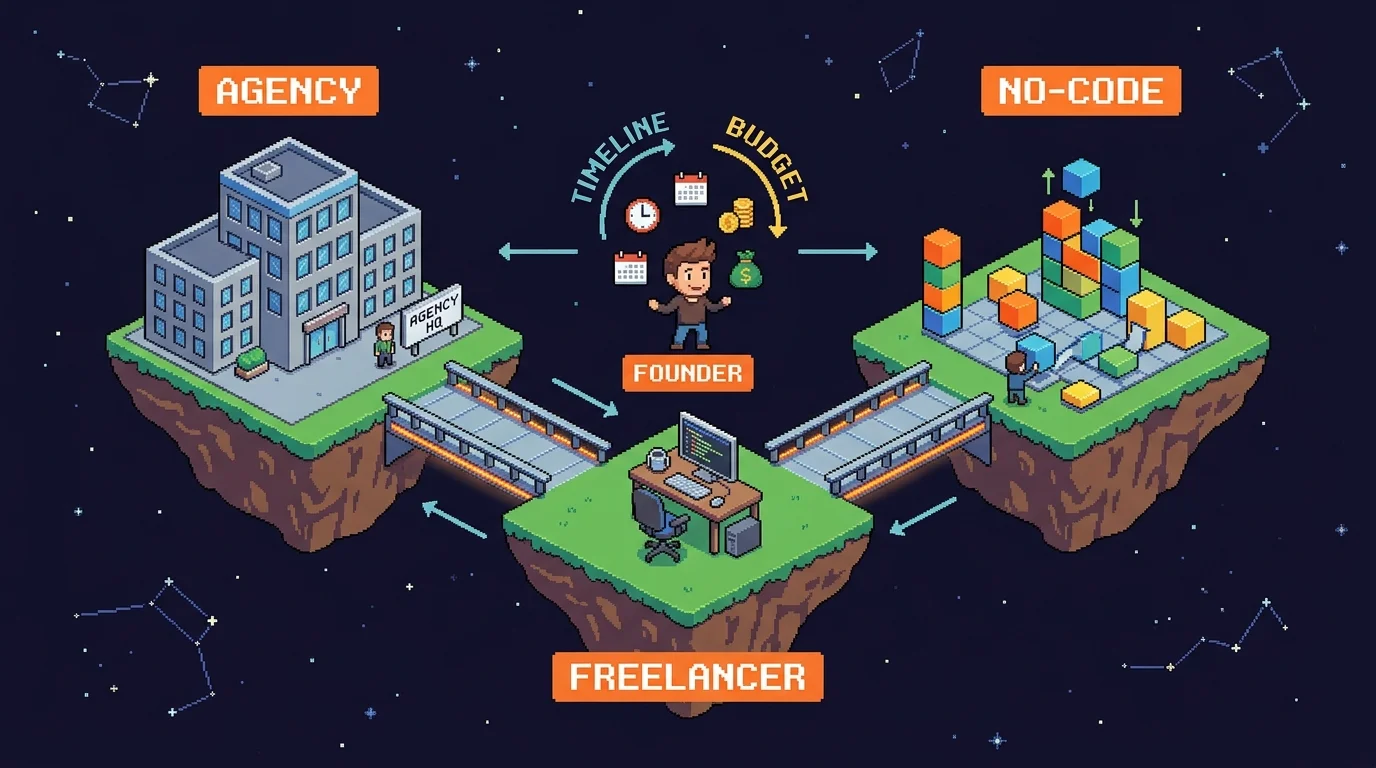
Choosing between an agency and a freelancer for MVP development feels like a tactical decision—but it's actually a strategic one that shapes your entire startup journey. This isn't just about cost; it's about control, speed, accountability, and whether you'll have a technical partner who understands your vision or a vendor working to a statement of work. For non-technical founders, this choice determines whether you're outsourcing a project or outsourcing your technical future.
The stakes are real. A freelancer might deliver code faster and cheaper, but you'll own the complexity of managing them. An agency brings structure and accountability, but less flexibility and higher upfront costs. And then there's the question of what happens next—when you need to iterate, scale, or pivot. Understanding these tradeoffs before you hire is the difference between launching smoothly and spending months untangling technical debt.
Quick Answer: Choose an agency if you want predictable delivery, full accountability, and a partner who handles the entire stack without you managing developers. Choose a freelancer if you have a clear, narrow scope, a tight budget, and the bandwidth to oversee their work closely. Most non-technical founders building their first SaaS product find an agency model less risky—you eliminate the overhead of recruiting and managing technical talent while getting production-ready code from day one.
This article breaks down the real decision factors: timeline and speed, cost structure, quality and accountability, team management overhead, and what happens after launch. By the end, you'll know exactly which path fits your situation—and avoid the costly mistakes that come from choosing wrong.
Table of Contents
For 2026 price ranges by complexity tier, see our full MVP development cost guide.
What You're Really Buying: Code Quality, Accountability, and Long-Term Viability
The cheapest MVP isn't always the smartest investment. When you hire a freelancer or agency, you're not just paying for code—you're paying for the foundation your business will either scale on or struggle against for years.
Consider the difference between proof-of-concept code and production-ready code. A no-code builder like Lovable or Bolt can spin up a working demo in days. It feels like victory. But according to research on low-code and no-code platforms, 25–30% of no-code SaaS projects get rewritten in custom code within two years due to performance limits, scalability walls, and feature ceilings. You've built on sand. When you need to add payment processing, handle 10,000 concurrent users, or integrate with third-party APIs, the no-code tool hits its ceiling—and you're back to square one.
A custom development partner delivers differently. They architect for what comes after launch. Production-ready code means user authentication that doesn't leak data, payment systems that handle edge cases, and infrastructure that scales. It means technical debt doesn't compound into a $4.7 million problem down the road. This isn't theoretical: developers spend nearly 42% of their time fighting technical debt and bad code foundations, according to the Stripe Developer Coefficient Report.
Freelancers can deliver quality code, but accountability is asymmetrical. When something breaks post-launch, a freelancer may have moved on. An agency owns the outcome. They're contractually responsible for handoff, documentation, and transition support—the unsexy work that determines whether your product actually survives its first scaling moment.
The real question isn't "Can I build this cheaper?" It's "What will it cost me to fix this in six months?" When you build without a technical co-founder, choosing the right partner determines whether Day 100 feels like momentum or firefighting.
Agencies vs. Freelancers: Side-by-Side Comparison of Cost, Speed, and Risk
Factor
Agencies
Freelancers
Pricing Model
Fixed-price or retainer (predictable)
Hourly ($15–$150/hr) or project-based (variable)
Total MVP Cost
$35,000–$120,000
$12,000–$35,000
Timeline
4–6 weeks (structured sprints)
2–4 months (variable, context-dependent)
Quality Consistency
High (process-driven, QA built-in)
Moderate to high (depends on individual)
Post-Launch Support
Included (handoff, docs, transition)
Limited (may have moved on)
Accountability
Contractual (owns the outcome)
Limited (no SLA guarantees)
Founder Oversight
Minimal (you receive updates)
High (you manage the relationship)
Risk of Technical Debt
Lower (production-ready standards)
Higher (shortcuts to meet budget)
The Cost Trade-Off
Freelance MVP development costs range from $12,000 to $35,000, while agency builds for the same MVP range from $35,000 to $120,000, according to Empyreal Infotech's 2026 pricing analysis. The gap exists because agencies bundle process, documentation, and accountability. Freelancers offer cost savings but require founder involvement in project management, testing, and risk mitigation.
Speed vs. Predictability
Agencies operate on fixed-price contracts tied to defined timelines—typically 4 weeks for a scoped MVP. You know the cost before code is written. Freelancers often work hourly or project-based, which means scope creep and timeline drift are common. A "4-week MVP" can stretch to 8 weeks if requirements shift or the freelancer takes on other clients.
The Accountability Question
Over 50% of projects fail to meet budget, timeline, or requirements, according to the Standish Group. When a freelancer disappears post-launch, you're left debugging production issues alone. Agencies remain contractually responsible for handoff, documentation, and transition support—the unglamorous work that determines whether your product survives its first scaling moment.
When Each Wins
Choose a freelancer if you have a small, well-defined scope, a technical founder who can oversee quality, and flexibility on timeline. Choose an agency if you need production-ready code delivered fast, predictable costs, and someone accountable when things break. For non-technical founders building without a technical co-founder, agencies eliminate the overhead of managing a distributed developer and reduce the risk of inheriting unmaintainable code.
Beyond the Comparison: Security, IP Ownership, and Long-Term Scalability
The agency-versus-freelancer decision often hinges on visible factors: cost, timeline, and portfolio. But the decisions that determine whether your MVP survives scaling—and whether you actually own what you've built—live in the fine print. These hidden factors separate a throwaway prototype from a defensible, compliant product.
IP Ownership: Who Really Owns Your Code?
This is non-negotiable. A freelancer contract that doesn't explicitly transfer intellectual property (IP) rights to you means the developer retains ownership. They can reuse your architecture for competitors, or worse, hold your codebase hostage if disputes arise. Agencies typically transfer full code ownership as standard practice, but verify this in writing before signing. Red flag: any vendor unwilling to transfer source code or infrastructure access to you post-launch.
Security and Compliance Aren't Optional
If you're building in regulated spaces—fintech, healthcare, SaaS handling user data—compliance isn't a nice-to-have. According to research on HIPAA compliance, non-compliance can result in fines up to $50,000 per violation, even at the MVP stage. A freelancer working solo rarely has the infrastructure, documentation, or audit trails required for HIPAA, PCI DSS, or SOC 2 compliance. Agencies build compliance into their process from day one because they're contractually liable for breaches. For bootstrapped MVPs with no regulated data, this matters less. For funded startups or those handling sensitive information, it's existential.
Vendor Lock-in and Post-Launch Support
Freelancers vanish after launch. Agencies remain contractually responsible for handoff documentation, knowledge transfer, and transition support. When production breaks at 2 a.m., you need someone accountable. Additionally, consider how you'll scale: can you easily hire developers to maintain freelancer-written code, or is it so idiosyncratic that you're locked into that one person? The best way to build an MVP—whether through agency or freelancer—includes a clear exit strategy and maintainable, well-documented code that doesn't depend on its original author.
When to Demand These Protections
If you've raised funding or plan to, demand full IP transfer, security documentation, and transition support in writing. If you're bootstrapped and testing a hypothesis, these protections matter less—but don't skip them entirely. A simple contract clarifying ownership takes one hour and prevents months of legal friction later.
Hybrid Models and Alternative Approaches: Agency + Freelancer + No-Code
The binary choice between agency and freelancer is increasingly false. Many founders discover that the optimal path combines multiple approaches: a specialized agency handling core product logic, freelancers tackling secondary features, and no-code tools accelerating non-critical workflows. This hybrid strategy can compress timelines and reduce costs—but only if you understand the coordination overhead and technical debt tradeoffs.
No-code platforms like Bubble and Lovable excel at speed. You can prototype a landing page, user dashboard, or internal workflow in days rather than weeks. However, the no-code-to-custom migration is where founders hit walls. Bubble's proprietary architecture makes it difficult to export logic into a real SaaS product. When you outgrow the platform, you're not upgrading—you're rebuilding from scratch. This isn't a limitation of the tool; it's the cost of the speed premium. Founders who treat no-code as a permanent solution rather than a validation stage often face expensive rewrites within 12–18 months.
AI-assisted development tools like Cursor and Bolt present a middle ground. They reduce custom development costs by 30–40% through intelligent code generation, but they still require a developer to review, test, and integrate the output. They're not a replacement for technical expertise—they're a force multiplier for it.
The hybrid model works best when roles are crystal clear: agency owns the database schema and payment logic (the hard parts), freelancers build UI components from specifications, and no-code handles customer-facing dashboards or admin panels. The failure mode is diffused accountability. When three parties touch the same codebase, debugging production issues becomes a blame game. Coordination overhead can erase cost savings.
If you pursue this path, establish a single source of truth for architecture decisions and enforce strict API contracts between components. Otherwise, you'll spend more time managing vendors than building product.
How to Evaluate and Hire the Right Partner: Red Flags and Hiring Signals
Vetting a development partner is where theory meets reality. A polished portfolio and confident pitch mean nothing if the partner disappears when bugs surface or refuses to discuss code ownership. The hiring process itself is your first test of communication style and professionalism.
Green Flags: What to Look For
Detailed proposals are non-negotiable. A partner who takes time to ask clarifying questions, breaks down deliverables into phases, and explains their technical approach is already demonstrating accountability. Request case studies with specific metrics—not vague testimonials. How long did the project take? What was the final cost? Can you speak to the client directly? References matter only if you actually call them. Ask about communication frequency, how conflicts were resolved, and whether the project stayed on budget.
Trial projects reveal everything. A small $2,000–$5,000 engagement (a single feature or integration) shows how a partner handles scope, revision requests, and documentation. You'll see their actual process, not their sales pitch. Clear contracts with defined milestones, payment schedules, and IP ownership clauses protect both parties. A partner unwilling to discuss these details is a red flag disguised as flexibility.
Red Flags: Walk Away
Pricing that seems too cheap relative to scope usually means corners will be cut or the project will stall. Freelancers quoting $5,000 for a full SaaS MVP aren't underpricing—they're either inexperienced or planning to deliver something you'll need to rebuild. Partners with no references, no portfolio, or only generic testimonials have something to hide. Unwillingness to discuss code ownership, architecture decisions, or technical debt is disqualifying. If they can't explain their process clearly, they don't have one.
Communication red flags include slow response times, vague status updates, or resistance to regular check-ins. These predict project friction. When evaluating an agency versus a freelancer for your MVP, prioritize partners who treat your project as a strategic partnership, not a transaction. The cheapest option rarely becomes your technical cofounder alternative—the most transparent one does.
Making Your Final Decision: A Framework for Choosing Your MVP Development Partner
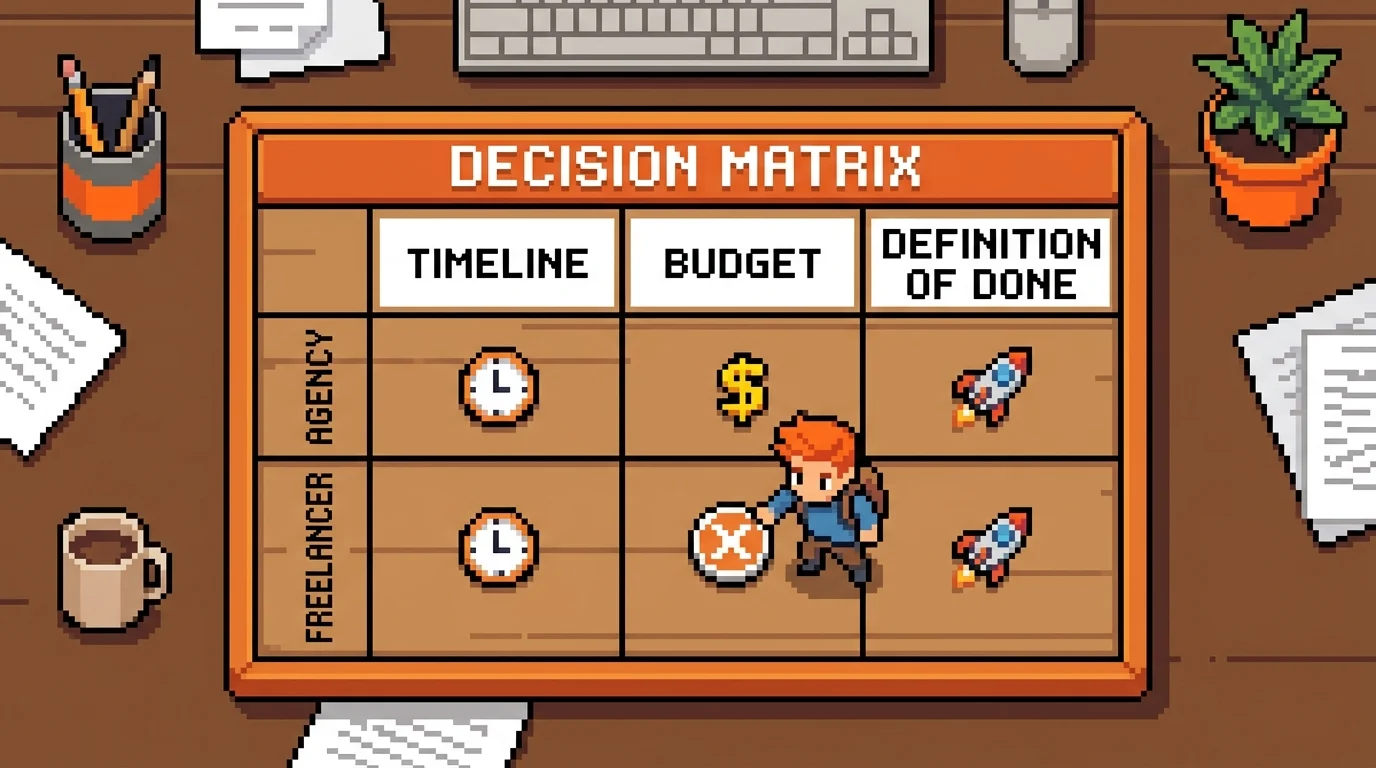
The decision between hiring an agency or freelancer for your SaaS MVP ultimately comes down to three interconnected variables: your timeline, your budget, and your definition of "done."
Start by clarifying what production-ready actually means for your product. A demo that impresses investors is fundamentally different from a system handling real payments, user authentication, and production infrastructure. If you need a clickable prototype to validate your idea, a skilled freelancer can deliver that in weeks at lower cost. If you need a fully deployed product with integrated payments and scalable architecture, you're buying accountability and technical depth—areas where agencies excel.
Next, assess your own capacity to oversee development. Non-technical founders who can dedicate 5-10 hours weekly to communication and feedback loops often succeed with freelancers. Those without that bandwidth benefit from agencies that manage their own project flow without requiring founder involvement in technical decisions.
Use this checklist to vet your next partner:
Does their portfolio show production-ready code, not just demos?
Can they explain their process clearly in non-technical terms?
Are contracts explicit about code ownership, milestones, and payment schedules?
Do they have verifiable references from founders in your industry?
Are they transparent about technical debt and long-term scalability?
The cheapest option rarely becomes your technical cofounder alternative. The most transparent one—the partner who treats your vision as a strategic partnership and delivers code you own outright—does. When you're ready to evaluate partners against these criteria, schedule a consultation to discuss your specific needs and timeline.
Article FAQ
Practical next steps
Who is this MVP guide for?
This guide is written for non-technical founders, operators, and small teams who need to make product decisions before hiring a full engineering team. It focuses on practical scope, cost, timeline, and execution trade-offs rather than abstract startup theory.
What should I do after reading this article?
Turn the idea into a small decision: validate the riskiest assumption, estimate the build scope, and decide whether the first version should be no-code, custom code, or a hybrid. Shipkit's free estimate and MVP scope builder can help you translate the article into a concrete plan.
Can Shipkit help implement this kind of product?
Yes. Shipkit helps founders turn validated ideas into fixed-scope MVPs, SaaS products, internal tools, marketplaces, and AI-enabled workflows. The best starting point is to get an estimate or compare your build path before committing budget.