Startup App Development Estimate Checklist: Plan Your MVP Scope, Budget & Timeline
Alex
··20 min read
A startup app development estimate checklist is a structured framework that helps non-technical founders document their MVP scope, budget constraints, timeline expectations, required integrations, and technical unknowns before requesting quotes from development agencies. Before you reach out to a development agency for a startup app development estimate, you need a clear picture of what you're actually building. Most non-technical founders approach this backwards—they contact agencies with vague ideas, get wildly different quotes, and walk away confused about what drives costs and timelines. This happens because estimates require specificity. Without it, you're asking developers to guess, and their guesses rarely align with your expectations or budget.
An app development estimate checklist solves this problem by forcing you to answer hard questions upfront: What features are truly essential for launch? Which integrations do you actually need? What's your realistic timeline? When you can articulate these details before getting quotes, you'll receive comparable estimates from multiple agencies, spot red flags in proposals, and avoid the scope creep that derails most startup projects.
This guide provides a structured checklist to define your MVP scope, budget envelope, timeline, integrations, and technical risks—the five dimensions that determine what your app costs to build. You'll learn what agencies actually look for when estimating, which questions to ask before signing any contract, and how to recognize when an estimate is too low (a warning sign) or suspiciously high.
Quick Answer: A startup app development estimate checklist is a structured framework that helps non-technical founders document their MVP scope, budget constraints, timeline expectations, required integrations, and technical unknowns before requesting quotes from development agencies. Without this preparation, founders typically receive inflated or unrealistic estimates and experience scope creep during development. Using this checklist ensures you get accurate, comparable quotes and avoid mismatched expectations with your development partner.
Why Founders Fail at App Cost Estimates—And How to Avoid It
For 2026 price ranges by complexity tier, see our full MVP development cost guide.
Non-technical founders typically underestimate app development costs by 40–60% because they don't account for the hidden complexity beneath surface-level features. When you say "I need a user login system," you're thinking of a single checkbox on a feature list. A development agency is thinking about password hashing, session management, two-factor authentication, account recovery flows, role-based access control, and compliance with data protection standards. That one "feature" expands into weeks of work—and your estimate was already too low before the conversation started.
The gap between founder expectations and agency reality stems from five recurring mistakes:
Undefined Scope
Most founders arrive at estimation calls with a vague product description: "It's like Uber but for dog walking" or "A Slack alternative for construction teams." Agencies can't quote a blurry idea. They'll either pad estimates to cover unknowns (making the price look inflated) or give you a dangerously low number that guarantees scope creep later. Without a clear list of must-have features versus nice-to-haves, you'll argue about what's included every time a change request appears.
Scope Creep During Development
According to research on project management, over 52% of software projects experience scope creep, and it can lead to cost overruns up to 4 times the initial estimate. A founder approves the initial estimate, development begins, and three weeks in you realize you need a reporting dashboard, or the payment flow needs to support multiple currencies, or the mobile app should work offline. Each request feels small in isolation—"just add this one thing"—but collectively they derail timelines and budgets.
Mismatched Expectations with Agencies
You think "4-week build" means 4 weeks of coding. The agency means 4 weeks of calendar time, which includes discovery, design reviews, testing, and deployment. You expect unlimited revisions; the agency budgeted for two rounds. You assume the code will be yours; the agency retains IP until final payment. These disconnects surface only after the contract is signed, when renegotiation becomes expensive and painful.
Skipping Technical Discovery
Many founders jump straight to cost estimates without exploring technical unknowns. Does your app need real-time notifications? How many concurrent users will it support? Should data sync across devices? Do you need a mobile app immediately, or is a responsive web app sufficient? These questions dramatically affect architecture, timeline, and cost. Agencies that skip discovery either lowball estimates (and miss deadlines) or inflate them (and lose the deal to competitors).
Ignoring Integration and Infrastructure Costs
Founders often think "build the app" means just the user-facing features. But production apps require payment processing (Stripe, PayPal), email delivery (SendGrid, Mailgun), authentication (Auth0, Firebase), hosting (AWS, Vercel), monitoring, backups, and security. These integrations and infrastructure components add 20–30% to development costs and are frequently forgotten in initial estimates.
The checklist below prevents these mistakes by forcing you to articulate scope, budget constraints, timeline expectations, and technical unknowns before you request quotes. With this preparation, you'll receive comparable estimates from multiple agencies, spot red flags in proposals, and avoid the scope creep that derails most startup projects.
The Complete App Development Estimate Checklist: Five Core Blocks
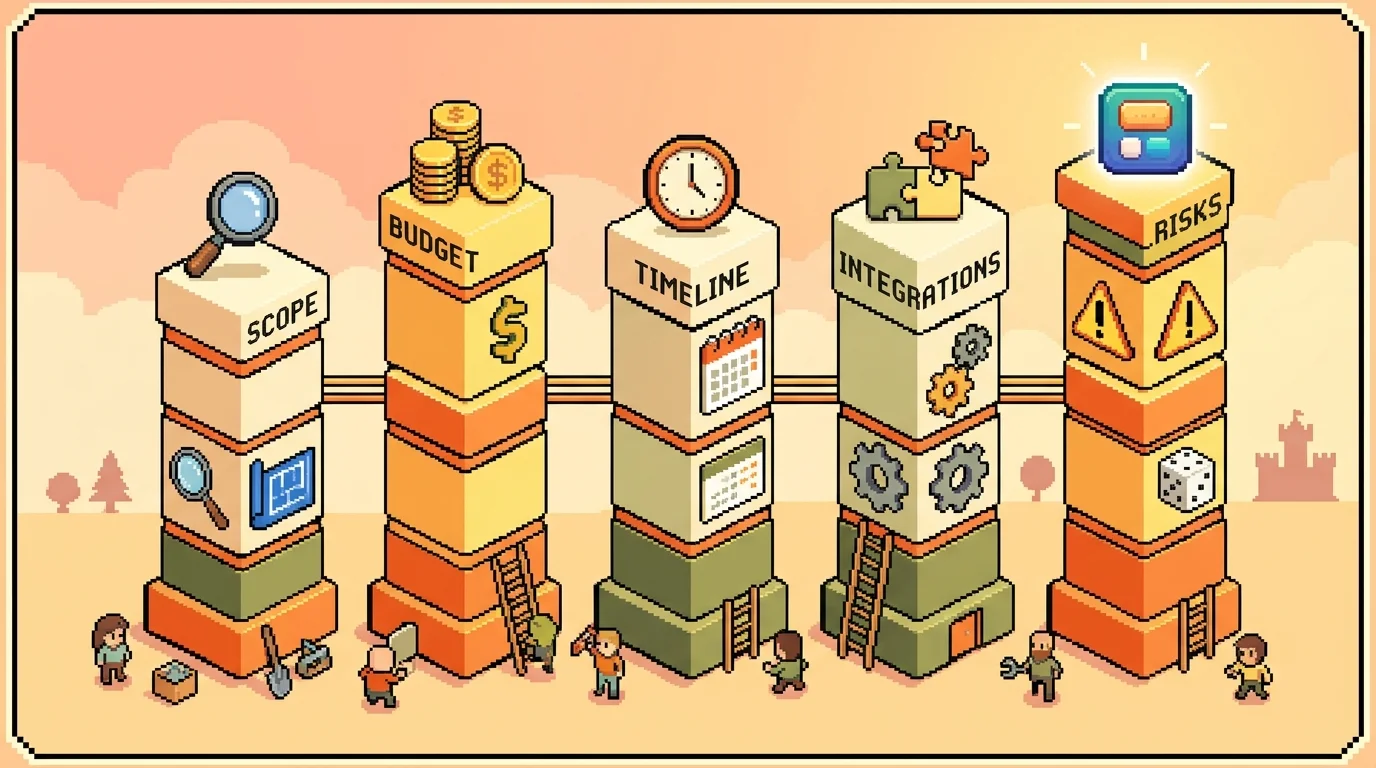
This is the framework that separates founders who get realistic quotes from those who get blindsided by scope creep and budget overruns. The five blocks below force you to articulate what you're actually building, what it costs, when it ships, what external systems it depends on, and what unknowns could derail the project. Fill in each block before you contact a development agency. You'll receive comparable estimates, spot red flags in proposals, and avoid costly mid-development surprises.
Block 1: Scope & Feature Inventory
Define your MVP with surgical precision. List every screen, user flow, and feature—but only what’s essential for launch. Use a prioritization matrix: Must-have (core functionality), Should-have (important but deferrable), Could-have (nice-to-have), Won’t-have (excluded from MVP). For example, a food delivery app’s “must-haves” include user registration, restaurant listing, cart/checkout, and order tracking. Push advanced filters, loyalty programs, or AI recommendations to post-MVP.
Break down features into granular tasks. Instead of “user login,” specify: email/password registration, social login (Google, Apple), password reset flow, session persistence, and profile management. Agencies estimate based on task complexity, not vague feature names.
Avoid feature bloat. Every additional feature increases testing, maintenance, and integration effort. Founders often overestimate what users need at launch. Focus on solving one core problem exceptionally well.
Block 2: Budget Envelope
Set a realistic budget range based on your funding stage. Pre-seed startups typically allocate $25K–$75K for MVP development; post-seed, $75K–$150K. Be transparent with agencies about your constraints. A credible agency will suggest scope adjustments to fit your budget—not promise unrealistic deliverables.
Factor in hidden costs: UI/UX design (15–20% of total), third-party tools (subscriptions), QA/testing (10–15%), project management, and post-launch support. A $50K dev quote can easily become $65K+ with overhead.
Define your pricing model preference: fixed bid (predictable cost, less flexibility), time-and-materials (flexible, risk of overruns), or milestone-based (balanced approach). Each has trade-offs. Fixed bids require ultra-clear scope; time-and-materials demand strong oversight.
Block 3: Timeline & Milestones
Establish a realistic launch timeline. Most MVPs take 3–6 months from kickoff to launch. Break the project into phases: discovery (1–2 weeks), design (3–5 weeks), development (8–16 weeks), QA/testing (2–4 weeks), and deployment.
Set clear milestones with deliverables:
Week 2: Approved wireframes
Week 5: Final UI designs
Week 8: Backend API complete
Week 12: Feature-complete beta
Week 16: Launch-ready app
Avoid arbitrary deadlines. “We need it in 4 weeks” signals inexperience and raises red flags. Agencies may pad estimates or cut corners. Align timelines with technical reality, not investor meeting dates.
Block 4: Integrations & Infrastructure
Every third-party integration adds complexity, development time, and ongoing costs. Identify all required dependencies early:
Required features (e.g., recurring billing, multi-currency support)
Data flow between systems
API rate limits and reliability
Subscription costs and scalability pricing
Each integration typically adds 10–30 hours of development and testing. Complex ones (like PCI-compliant payments or HIPAA-compliant data handling) can take weeks. Ignoring these in your estimate leads to budget overruns and delayed launches.
Block 5: Technical Risks & Unknowns
Surface hidden technical challenges early by asking your development agency these critical questions:
Do we need to integrate with legacy systems or third-party APIs with poor documentation? Unstable or undocumented APIs increase risk and estimation uncertainty.
Are real-time features required? (e.g., live chat, location tracking, push notifications). These demand specialized infrastructure (WebSockets, Firebase, Pusher) and add 20–40% to development effort.
What are our scalability targets? Supporting 1,000 concurrent users vs. 100,000 requires vastly different architectures. Ask: “What’s the expected user load at 6 and 12 months?”
Are there compliance requirements? (e.g., GDPR, HIPAA, CCPA, PCI-DSS). Compliance affects data storage, encryption, audit logging, and increases legal and dev costs.
What security measures are non-negotiable? (e.g., end-to-end encryption, penetration testing, SOC 2 compliance). Security isn’t optional—it’s baked into architecture.
Are there offline functionality or cross-device sync needs? These require complex state management and conflict resolution logic.
What performance benchmarks must we meet? (e.g., sub-2s load time, 99.9% uptime). Performance targets influence tech stack and hosting choices.
Discussing these risks upfront helps agencies provide more accurate estimates and propose mitigation strategies—rather than discovering showstoppers mid-project.
10 Critical Questions to Ask Agencies Before Getting a Quote
Before you request a startup app development estimate, vet your potential development partners thoroughly. Asking the right questions ensures you’re comparing apples to apples and avoids costly misunderstandings down the line. Here are 10 essential questions to ask—each designed to uncover how agencies approach estimation, manage scope, and handle technical complexity.
How do you arrive at your estimate? Ask whether they use T-shirt sizing, story points, or three-point estimation. A credible agency should be transparent about their methodology and able to explain how they account for uncertainty.
Can you break down the estimate by feature and phase? You need visibility into how much design, development, testing, and project management contribute to the total cost. This also helps you prioritize features during MVP scoping.
What’s included—and what’s not? Clarify whether hosting, third-party integrations, UI/UX design, and post-launch support are part of the quoted price. Hidden exclusions are a common source of budget overruns.
Have you built apps similar to mine? Can I see a case study? Experience matters. Request examples of past projects, especially those in your industry or with similar technical requirements.
How do you handle scope changes during development? Scope creep kills startups. Find out if they use change orders, how they price additional features, and whether they offer flexible sprint planning.
What’s your process for technical discovery? A proper discovery phase uncovers risks early. If an agency skips this step, their estimate is likely a guess—not a reliable forecast.
Who owns the code and IP upon delivery? Ensure full ownership transfers to you after final payment. Some agencies retain rights unless explicitly agreed otherwise.
How do you ensure the app is scalable and maintainable? Ask about architecture decisions, code documentation, and testing practices. A cheap build today can become a six-figure refactor tomorrow.
What tools and frameworks do you recommend—and why? Their tech stack should align with your long-term goals (e.g., cross-platform support, integration needs, team scalability).
Can I use your estimate to secure funding or plan my runway? The best estimates are detailed enough to justify expenses to investors. If they can’t provide a clear, itemized breakdown, reconsider.
For a faster, more accurate starting point, consider using our MVP Scope Builder tool to define your core features before reaching out to agencies. This not only streamlines the quoting process but also ensures you’re prepared to evaluate proposals with confidence.
How Development Agencies Actually Estimate Startup Apps
Estimation isn't magic—it's a structured process that separates realistic quotes from guesses. Most agencies use one of three proven methods, each with trade-offs. Understanding how they work gives you confidence that the estimate you receive is grounded in real experience, not pulled from thin air.
T-Shirt Sizing: The Fast, Rough Method
T-shirt sizing (XS, S, M, L, XL) is the quickest estimation approach. An agency reviews your requirements and assigns a bucket: a simple CRUD app with basic auth might be "Small" (4–6 weeks, $8K–$15K), while a marketplace with real-time notifications and two-sided payments is "Large" (10–14 weeks, $40K–$70K).
This method works early in discovery when requirements are fuzzy. It's fast—a senior developer can size a spec in an hour. But it's also coarse. Two "Medium" projects can diverge wildly once you dig into details. T-shirt sizing is useful for a ballpark conversation ("Is this a $10K or $100K project?"), but it shouldn't be your final quote. A reputable agency will use it to filter scope, then move to a more precise method before you sign a contract.
Story Points: The Agile Standard
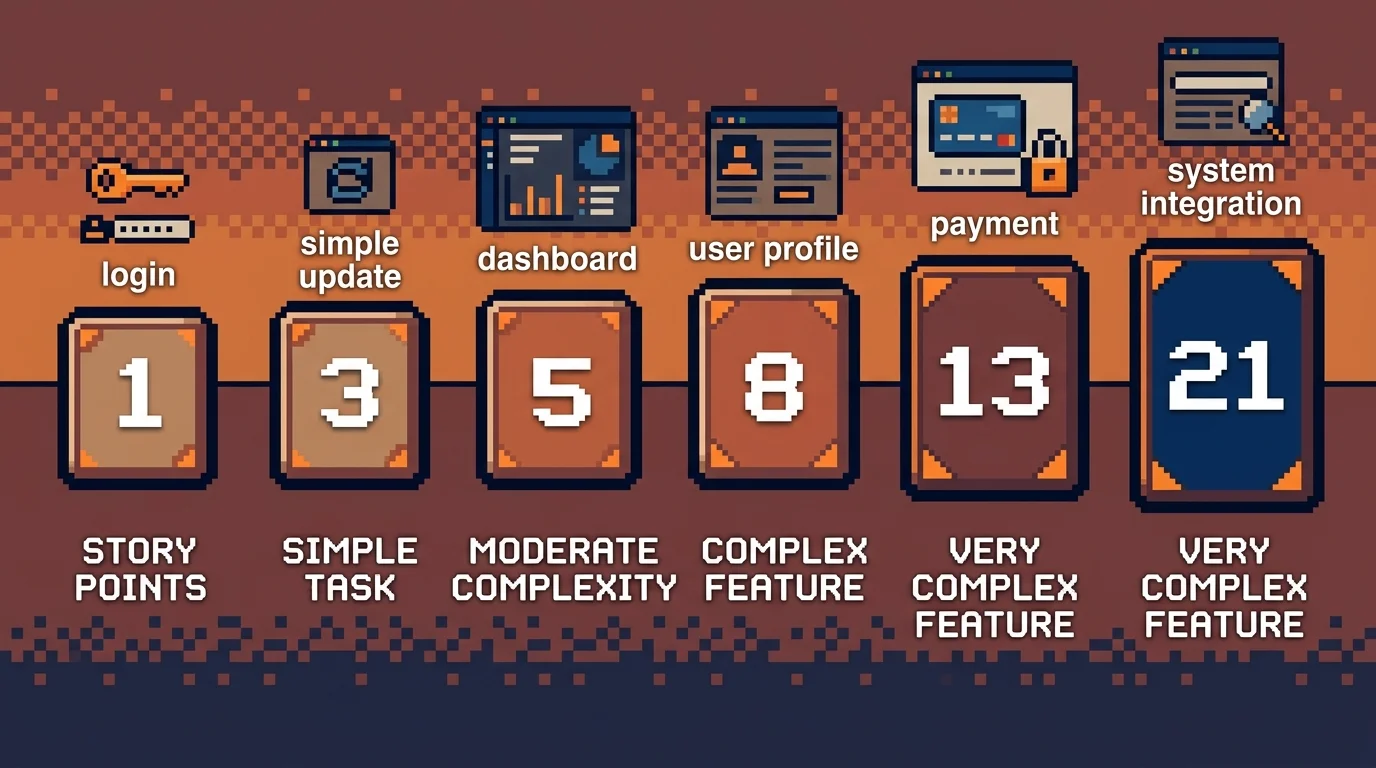
Story points assign effort units (1, 2, 3, 5, 8, 13, 21) to individual features or tasks. A login flow might be 3 points, a payment integration 8 points, a real-time dashboard 13 points. The agency totals the points, then converts them to time and cost using a velocity baseline ("we deliver 40 points per week at $2K per point").
Story points excel at breaking large projects into digestible pieces. They force the agency to think about dependencies—does the payment system depend on user roles? That changes the estimate. They also create a shared language between you and the team. When scope creep happens, you can see it: "That feature adds 5 points, which means 3 extra days and $1.5K."
The catch: story points are relative, not absolute. A point means nothing without the team's velocity. Different agencies will estimate the same feature differently. Use story points when you've hired an agency and want to track progress, not when comparing quotes from multiple vendors.
Three-Point Estimation: The Realistic Approach
Three-point estimation asks: What's the optimistic timeline (best case), realistic timeline (most likely), and pessimistic timeline (if everything goes wrong)? An agency might estimate a feature as:
Optimistic: 2 days
Realistic: 5 days
Pessimistic: 10 days
Then they apply a weighted formula: (Optimistic + 4 × Realistic + Pessimistic) ÷ 6. This gives 5.3 days—higher than optimistic, but acknowledging real risk. Multiply across all features, add 15–20% buffer for unknowns, and you have a defensible estimate.
This method is honest about uncertainty. It doesn't pretend precision where none exists. Mature agencies use three-point estimation because it matches how software actually gets built: some things go faster, some hit snags, and the average lands somewhere in the middle.
Real Example: Estimating a Marketplace MVP
Let's walk through how an agency might estimate a two-sided marketplace (like Airbnb for tools, Etsy for local services). The spec includes:
User signup and profiles (buyer and seller sides)
Listing creation and search
Messaging between buyer and seller
Payment processing via Stripe
Reviews and ratings
Admin dashboard for moderation
T-shirt sizing: "This is a Large. 12 weeks, $50K–$70K."
Total: 68 points. At 40 points per week, that's 1.7 weeks—clearly too optimistic. The agency then adds buffer for unknowns (messaging libraries, payment edge cases, hosting setup): 85 points. At $2K per point, that's $170K. But that's too high for an MVP.
So they scope ruthlessly: remove real-time messaging (use polling instead), simplify the admin dashboard, cut advanced search. Now 55 points, $110K. Still high. They propose a phased approach: Phase 1 (core marketplace) is 35 points ($70K, 9 weeks), Phase 2 (messaging and reviews) is 20 points ($40K, 5 weeks).
Three-point estimate for Phase 1:
Optimistic: 7 weeks
Realistic: 9 weeks
Pessimistic: 13 weeks
Weighted: 9.3 weeks, ~$72K
This is how mature agencies work. They don't give you one number—they give you a range, explain the variables, and show you where they're uncertain. They also show you how to reduce cost: cut features, accept longer timelines, or reduce quality (more bugs in beta).
Why Estimation Methods Matter for Your Funding Conversation
If you're raising money, investors want to see that your development partner has thought through risk. An agency that says "We'll build your SaaS in 8 weeks for $40K" is either lying or inexperienced. An agency that says "Core MVP is 9–11 weeks for $60K–$75K, assuming stable scope and weekly check-ins" signals they've done this before.
When comparing quotes from multiple agencies, don't just compare the final number. Compare the method. Did they ask discovery questions? Did they break down the estimate by feature? Did they flag risks? An agency using fixed-price development should show you the detailed breakdown that justifies the price—not hide it behind a contract.
Shipkit uses a hybrid approach: we start with story points during discovery, then lock in a fixed price once the spec is detailed. This gives you certainty (no surprise invoices) and flexibility (we adjust scope if needed, not timeline or cost).
Web App vs. Mobile App: How Estimates Differ
Choosing between a web app, native mobile app, or cross-platform solution directly impacts your development estimate. Web app development estimates tend to be lower due to a single codebase and fewer deployment complexities. Mobile app development estimates rise when targeting iOS and Android separately—each requires platform-specific testing, compliance with app store guidelines, and optimization across fragmented device sizes and OS versions.
According to analysis by DBB Software, Android apps typically cost 10–15% more than iOS due to device fragmentation and extended QA cycles. Building both native platforms can nearly double effort. Cross-platform frameworks like React Native or Flutter reduce total cost by 30–40% compared to dual native builds, offering a balanced path for startups needing presence on all fronts without full duplication.
Each additional platform adds 25–40% to total project cost—not just in development, but in testing, maintenance, and release management.
Platform Approach
Relative Effort
Timeline Impact
Web App
1x
Base timeline
Native iOS
1.3x
+3–5 weeks
Native Android
1.4x
+4–6 weeks
Cross-platform (e.g. Flutter)
1.5x (covers both)
+6–8 weeks
Frequently Asked Questions About App Development Estimates
How much does an MVP actually cost? MVP costs range from $15,000 to $100,000+ depending on complexity, feature count, and platform choice. A simple web-based MVP with core features and basic integrations typically lands in the $25,000–$50,000 range, while multi-platform apps with advanced functionality (payments, user roles, real-time data) push toward $75,000–$150,000. The real driver isn't the idea—it's scope definition and how many integrations you need on day one.
How long does it take to build a SaaS MVP? Most SaaS MVPs take 8–16 weeks from discovery to launch, depending on feature complexity and team size. A tight, well-scoped product with 5–8 core features typically ships in 10–12 weeks; anything broader stretches to 4–6 months. Timeline compounds with platform choices—adding native mobile to a web app adds 6–10 weeks of parallel work. The key variable isn't effort alone; it's how clearly you've defined what "done" means before development starts.
Can I get an estimate without a detailed spec? Yes, but it will be a rough order of magnitude, not a binding quote. Agencies can provide a ballpark range ($30K–$60K) based on your description, but a real estimate requires a specification document outlining features, user flows, integrations, and technical constraints. Think of early estimates as directional—useful for budget planning, but not for contracts. Once you're serious about a partner, invest 1–2 weeks in a spec before asking for a fixed price.
What's the difference between an estimate and a quote? An estimate is an educated guess based on incomplete information; a quote is a binding commitment backed by a detailed specification. Estimates help you plan; quotes protect both you and the agency by defining exactly what gets built and for how much. Never sign a contract based on an estimate alone. Reputable agencies like Shipkit separate these phases deliberately—estimate first, spec second, quote third.
Should I go with fixed-price or time-and-materials? Fixed-price works best when your scope is locked and you've validated assumptions with users. Time-and-materials (T&M) protects you if you're still learning what your product needs, but it shifts budget risk to you. For MVPs, fixed-price with a clear spec reduces scope creep and gives you predictability; T&M invites endless tweaks. Fixed-price MVP development eliminates surprises and forces both sides to think clearly upfront.
How do I compare estimates from different agencies? Apples-to-apples comparison requires the same scope document sent to each agency. If estimates vary wildly ($30K vs. $120K), dig into what's included: Are they quoting the same features? Same platforms? Same timeline? Low estimates often hide scope—they quote the happy path and charge extra for integrations, testing, or deployment. Ask each agency to break down their estimate by role (design, frontend, backend, QA) and timeline. Cheapest rarely means best; mid-range agencies with clear methodology usually deliver better outcomes than bargain shops or premium-priced generalists.
What hidden costs should I budget for? Beyond development, budget for third-party services (Stripe fees, hosting, analytics), post-launch support (bug fixes, feature tweaks), and infrastructure scaling. Many founders forget that an estimate covers building the app—not running it. Hosting, monitoring, and security tools add $500–$2,000/month depending on scale. Also reserve 10–15% of your budget for scope creep or technical surprises discovered during development. If your estimate is $50K, plan for $55K–$57.5K in reality.
Ready to Estimate Your Startup App? Next Steps
You've now walked through the complete framework for preparing a realistic startup app development estimate. The checklist you've built—defining your scope, mapping your budget envelope, setting timeline expectations, identifying integrations, and surfacing technical risks—transforms vague conversations with agencies into precise, actionable quotes.
Founders who arrive at an agency with this preparation get three immediate advantages: faster turnaround on estimates (agencies don't need to chase you for clarifications), more accurate pricing (because scope is locked down), and fewer surprises during development. You've essentially done the discovery work upfront, which means the agency can focus on technical estimation rather than business translation.
The real power of this checklist isn't the document itself—it's the clarity it forces you to develop about your own product. When you're forced to articulate whether a feature is must-have or nice-to-have, or to define what "user authentication" actually means for your business model, you're making decisions that directly impact your budget and timeline. Agencies can't make those decisions for you. Your job is to be clear; their job is to be accurate.
What comes next depends on where you are in your journey.
If you're still refining your idea and want to stress-test your scope before talking to builders, use our MVP scope builder tool to lock down your feature list and get preliminary complexity estimates. This tool walks you through the same five blocks from the checklist and outputs a structured scope document you can send directly to agencies.
If you're ready to move toward concrete numbers, get an MVP cost estimate from our team. We'll use your completed checklist to give you a fixed-price quote with transparent breakdown by role (design, frontend, backend, QA, project management) and timeline. No hidden fees, no guesswork—just honest estimation based on what you're actually building.
For a real-world example of how this process plays out, see our marketplace MVP case study, which shows exactly how we estimated, scoped, and delivered a two-sided marketplace in 4 weeks with predictable costs.
At Shipkit, we turn your estimates into reality. We handle the complete build—from spec through deployment—so you own production-ready code from day one. No technical co-founder needed. Just a clear scope, a realistic budget, and a team that delivers what we quote.
Your next step is one conversation. Let's turn your idea into numbers, and those numbers into a shipped product.
Article FAQ
Practical next steps
Who is this MVP guide for?
This guide is written for non-technical founders, operators, and small teams who need to make product decisions before hiring a full engineering team. It focuses on practical scope, cost, timeline, and execution trade-offs rather than abstract startup theory.
What should I do after reading this article?
Turn the idea into a small decision: validate the riskiest assumption, estimate the build scope, and decide whether the first version should be no-code, custom code, or a hybrid. Shipkit's free estimate and MVP scope builder can help you translate the article into a concrete plan.
Can Shipkit help implement this kind of product?
Yes. Shipkit helps founders turn validated ideas into fixed-scope MVPs, SaaS products, internal tools, marketplaces, and AI-enabled workflows. The best starting point is to get an estimate or compare your build path before committing budget.