How Much Does It Cost to Build a Marketplace MVP in 2024
Alex
··10 min read
Building a marketplace MVP typically costs between $15,000 and $75,000, depending on complexity, feature scope, and your chosen development path. A basic two-sided marketplace with essential payment processing and user management lands around $20,000–$40,000, while more sophisticated platforms with advanced search, analytics, or specialized integrations push toward $50,000–$75,000 or beyond.
Quick Answer: Marketplace MVP development costs range from $15,000 to $75,000 in 2024, with most founders spending $25,000–$50,000 for a functional, launchable product. Your actual cost depends on feature complexity, payment system integration, and whether you're building a general marketplace or a niche vertical. Planning costs upfront prevents expensive pivots later—knowing your budget constraints before development begins ensures you build what matters most to early users.
A marketplace MVP is a stripped-down version of your two-sided platform: just enough features to connect buyers and sellers, process transactions, and gather user feedback. It's not a full-featured competitor—it's proof of concept. Cost planning matters because marketplace development involves multiple moving parts: user authentication, payment processing, search functionality, ratings systems, and dispute resolution. Miss the cost conversation early, and you'll either overspend on features nobody uses or underfund critical infrastructure that kills user trust.
This article walks you through the cost breakdown, explores what drives pricing up or down, compares development approaches, and shows you how to estimate your specific marketplace MVP investment.
Table of Contents
For 2026 price ranges by complexity tier, see our full MVP development cost guide.
Marketplace MVP Cost Breakdown by Complexity Level
Marketplace MVPs fall into three distinct tiers based on feature scope and user experience complexity. Understanding where your idea sits within this spectrum helps you allocate budget realistically and avoid building features that don't matter to early users.
Two-sided marketplaces with basic vendor dashboards and buyer accounts
Complex
$70,000–$120,000+
16–24 weeks
Full-featured platforms with messaging, advanced search, and dispute resolution
Simple marketplaces ($15K–$35K) work best for founders testing a specific vertical—think a hyper-local handyman marketplace or a niche resale platform. These include user registration, basic listings, search functionality, and Stripe Connect payment processing. You're not building vendor dashboards or complex review systems yet. This tier proves demand without overengineering.
Mid-range marketplaces ($35K–$70K) add the infrastructure that separates proof-of-concept from a real two-sided platform. According to MVP Development Cost for Startups Guide, a functional marketplace with basic search, listings, user accounts, and Stripe Connect integration typically costs $35,000–$70,000. You're now supporting vendor onboarding, basic transaction logic, and buyer-seller communication. This is where most founders should start if they're serious about marketplace validation.
Complex marketplaces ($70K–$120K+) handle advanced features: booking calendars, messaging systems, vendor analytics dashboards, and dispute workflows. These suit founders building full two-sided platforms with higher transaction volumes or specialized requirements. A two-sided marketplace with booking, payments, calendars, and dashboards costs around $45,000 and delivers in roughly 10 weeks, though enterprise-grade complexity pushes timelines and costs significantly higher.
Your actual spend depends on payment gateway complexity, whether you need real-time notifications, and how much customization your vertical demands. A niche vertical marketplace development might stay lean at $20K because your sellers have simple needs. A general two-sided marketplace features for v1 typically requires the mid-range investment to handle both buyer and seller workflows credibly.
Key Cost Drivers for Your Marketplace MVP
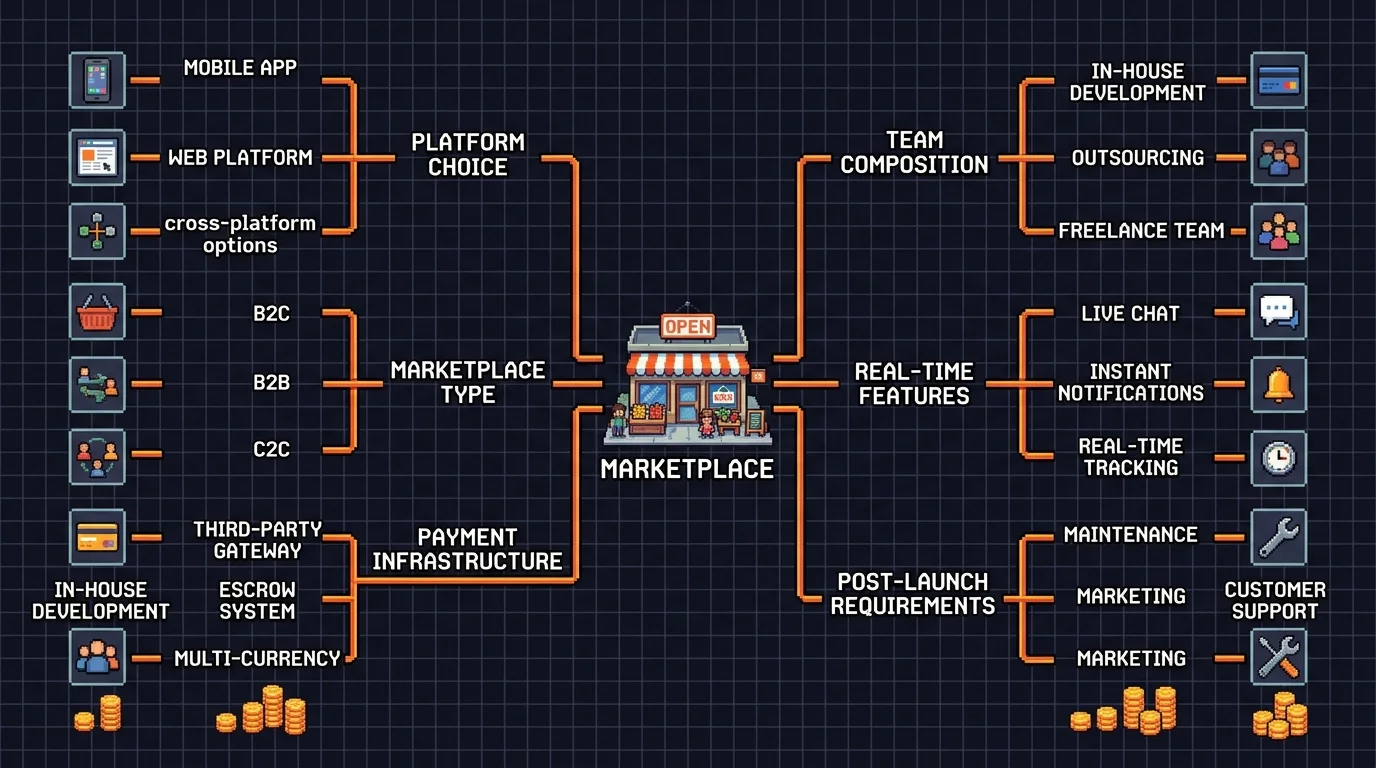
Your marketplace budget hinges on six critical decisions, each with direct financial consequences. Understanding these drivers helps you allocate resources strategically and avoid costly surprises mid-development.
Platform choice shapes your entire budget. Web-only marketplaces cost the least—typically $15K–$40K for a functional MVP. Mobile apps demand significantly more investment due to platform-specific optimization and app store requirements. According to Moveo Apps, cross-platform development typically costs 30–40% less than building native apps for both iOS and Android separately, making it a smart middle ground if mobile is essential from day one.
Marketplace type directly impacts feature complexity and cost. Retail marketplaces (like Etsy clones) need inventory management, search filtering, and shipping integration—expect $35K–$70K. Service marketplaces require booking calendars, availability management, and service-provider verification, pushing costs toward $50K–$80K. Reverse marketplaces, where buyers post requests and sellers bid, demand sophisticated matching algorithms and notification systems, often exceeding $60K.
Payment infrastructure varies dramatically by region and transaction type. Stripe Connect for vendor payouts costs less than building custom settlement logic. If you need multi-currency support or local payment methods, budget an additional $5K–$15K.
Team composition determines your burn rate. A full-time internal team costs $120K–$200K annually. Hiring a development agency with fixed-price delivery (like Shipkit's approach) eliminates scope creep and delivers faster—you pay once, own the code, and move forward. Freelancers are cheapest upfront but introduce timeline risk and quality variability.
Real-time features—live notifications, instant messaging, or activity feeds—add $8K–$15K. Basic email notifications cost far less.
Post-launch requirements matter equally. Admin dashboards for dispute resolution, vendor analytics, and fraud detection aren't MVP essentials but become critical within months. Plan $10K–$20K for these when budgeting your first year.
The founders who spend wisely start lean on platform (web first), choose their marketplace type carefully, and defer advanced features until post-launch validation proves demand.
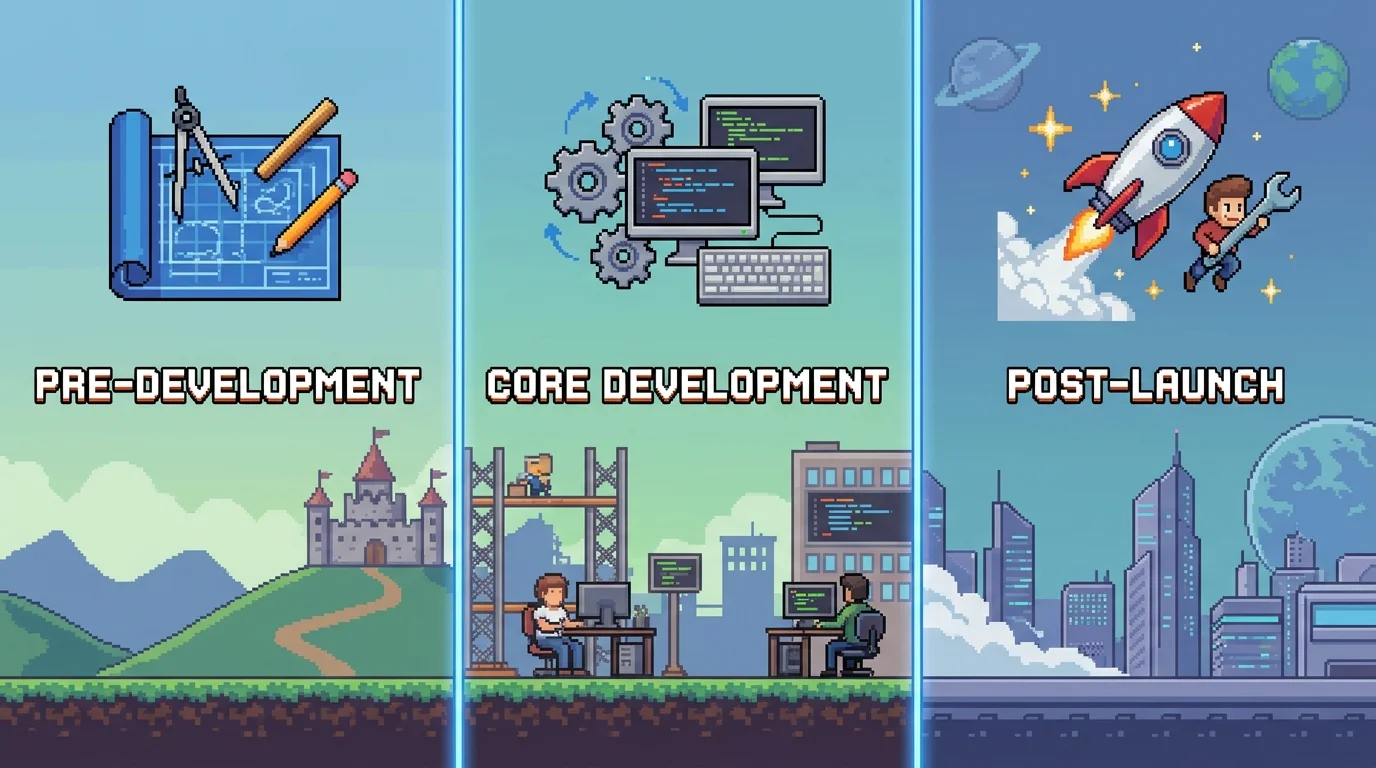
Pre-Development, Development, and Post-Launch Cost Phases
Marketplace MVP costs don't end when code ships—they span three distinct phases, each with different budget priorities and deliverables. Understanding this lifecycle prevents founders from underestimating total investment and helps allocate resources strategically.
Deployment, monitoring, bug fixes, marketplace admin dashboard enhancements, first-month support
15–25%
$2,250–$18,750
Pre-development is where clarity compounds. Rushing through specification leads to mid-build pivots that inflate costs by 20–40%. This phase includes user research, competitive analysis, wireframing, and detailed technical specification—essentially answering "what exactly are we building?" before engineering begins.
Core development consumes the majority of budget. This covers backend logic (vendor management, commission calculations, dispute handling), frontend interfaces, payment infrastructure setup, and foundational marketplace admin dashboard requirements for managing vendors and transactions. Choosing the right development partner matters here—fixed-price agency models eliminate scope creep, while hourly teams often exceed estimates.
Post-launch extends beyond launch day. According to Closeloop research, post-launch maintenance and bug fixes typically cost 15–20% of initial development annually. Budget $10K–$50K yearly for hosting, monitoring, vendor support, and iterating on payments and commissions features based on real transaction data. Advanced marketplace admin dashboard capabilities—fraud detection, analytics, dispute resolution workflows—become critical within months but aren't MVP essentials.
Founders who allocate budget across all three phases avoid the trap of "launching broke" and maintain momentum through the critical early validation period.
Proven Cost Reduction Strategies Without Compromising Quality
The gap between a $15,000 MVP and a $75,000 one often comes down to smart prioritization, not engineering quality. Here are the tactics that separate founders who launch lean from those who burn through budgets unnecessarily.
Ruthless feature prioritization remains your most powerful lever. Your marketplace launch checklist for founders should include only the absolute core: vendor onboarding, product listing, search, checkout, and basic admin controls. Everything else—reviews, advanced filtering, recommendation engines, fraud detection—belongs in post-launch iterations. This single decision can cut costs by 30–40% without delaying your first transaction.
Leverage low-code and no-code platforms when your marketplace fits their constraints. According to Gartner research, 70% of new apps will use low-code or no-code platforms by 2026 to accelerate delivery. White-label solutions like Sharetribe can reduce development time and cost by up to 90% compared to custom builds, delivering a functional marketplace for as little as $119 monthly or $20,000 for a turnkey setup. The trade-off: less customization and vendor lock-in, but you validate your business model months faster.
Open-source marketplace frameworks (WooCommerce multivendor, Medusa) cost nothing upfront but require experienced developers to implement correctly. This works if you already have technical co-founder capacity or hire a fixed-price agency to handle setup and customization.
Choose your team structure strategically. Agencies with fixed-price models eliminate scope creep and deliver predictable timelines—ideal when you need accountability. Freelancers cost less hourly but often exceed budgets on complex features. Offshore teams split the difference but require stronger specification and communication overhead.
Phased development defers non-critical infrastructure. Launch with basic email notifications instead of SMS; add advanced analytics dashboards after you have real transaction volume. This spreads costs across quarters and lets user feedback guide later spending.
The common thread: every dollar saved on unnecessary features is a dollar you can spend on payment infrastructure, security, and vendor support—the features that actually drive marketplace trust and transaction volume.
Common Questions About Marketplace MVP Development Costs
How much does a SaaS marketplace MVP cost? A functional marketplace MVP typically ranges from $15,000 to $75,000, depending on whether you're building a simple two-sided platform or a feature-rich ecosystem. The gap between low and high ends comes down to payment processing complexity, vendor onboarding flows, and transaction security—not flashy UI. A basic marketplace with Stripe integration, user authentication, and listing management lands around $25,000–$35,000. Add dispute resolution, commission tracking, or multi-currency support, and you're pushing toward $50,000+.
What's the cheapest way to build a marketplace MVP? Start with no-code platforms like Bubble or Webflow if your marketplace has straightforward workflows. You'll spend $5,000–$10,000 on setup and customization but sacrifice scalability later. For sustainable growth, use open-source frameworks (WooCommerce multivendor, Medusa) with a fixed-price agency handling implementation. This costs $20,000–$30,000 upfront but gives you code ownership and avoids vendor lock-in.
How long does marketplace development take? Expect 8–12 weeks for a basic marketplace, 12–16 weeks for mid-complexity. Phased development—launching core features first, adding analytics dashboards later—compresses initial timelines to 6–8 weeks and spreads costs across quarters.
What are hidden costs founders miss? Payment processing fees (2–3% per transaction), compliance and legal review ($3,000–$8,000), hosting infrastructure ($500–$2,000/month), and post-launch improvements. Most successful startups allocate about 50% of their initial development budget to improvements in the first year after launch, so plan accordingly.
Should we build web or mobile first? Launch web first. Mobile development adds 30–40% to costs and delays market entry. Responsive web design reaches 90% of users initially; native mobile apps follow once you have transaction volume justifying the investment.
How do we get an accurate cost estimate? Detailed specification beats guesswork. Document user flows, payment scenarios, vendor workflows, and reporting needs before requesting quotes. When comparing agencies, ask for fixed-price proposals with clear scope boundaries—this eliminates budget surprises and holds teams accountable to timelines.
Planning Your Marketplace MVP Budget: A Founder's Checklist
Your marketplace MVP cost isn't arbitrary—it's the direct result of five interconnected decisions. Before requesting quotes, work through this checklist to define your specific scope and arrive at a realistic budget.
Marketplace Type & Complexity: Are you building a service marketplace (Uber-style), product marketplace (eBay-style), or niche vertical? Service marketplaces require real-time matching logic and instant notifications; product marketplaces need robust search and inventory systems. This choice alone shifts costs by $10,000–$20,000.
Core Feature Set: Strip your launch to essentials: user registration, vendor onboarding, listing creation, search, payments, and order management. Every additional feature—reviews, messaging, analytics dashboards—adds 1–2 weeks and $3,000–$5,000. Prioritize ruthlessly.
Platform & Team Model: Web-first responsive design (6–8 weeks) costs less than simultaneous web and mobile (10–12 weeks). Hiring freelancers extends timelines; fixed-price agency partnerships compress them and eliminate scope creep.
Payment Processing & Compliance: Factor in payment gateway integration ($2,000–$4,000), legal review for vendor terms ($3,000–$8,000), and recurring processing fees (2–3% per transaction).
Timeline Flexibility: Phased launches reduce upfront costs. Launch with core transactions first; add analytics and vendor dashboards later.
Ready to translate this into a concrete estimate? Book a free founder call with Shipkit to get a fixed-price proposal for your specific marketplace vision—no surprises, full code ownership from day one.
Article FAQ
Practical next steps
Who is this MVP guide for?
This guide is written for non-technical founders, operators, and small teams who need to make product decisions before hiring a full engineering team. It focuses on practical scope, cost, timeline, and execution trade-offs rather than abstract startup theory.
What should I do after reading this article?
Turn the idea into a small decision: validate the riskiest assumption, estimate the build scope, and decide whether the first version should be no-code, custom code, or a hybrid. Shipkit's free estimate and MVP scope builder can help you translate the article into a concrete plan.
Can Shipkit help implement this kind of product?
Yes. Shipkit helps founders turn validated ideas into fixed-scope MVPs, SaaS products, internal tools, marketplaces, and AI-enabled workflows. The best starting point is to get an estimate or compare your build path before committing budget.